

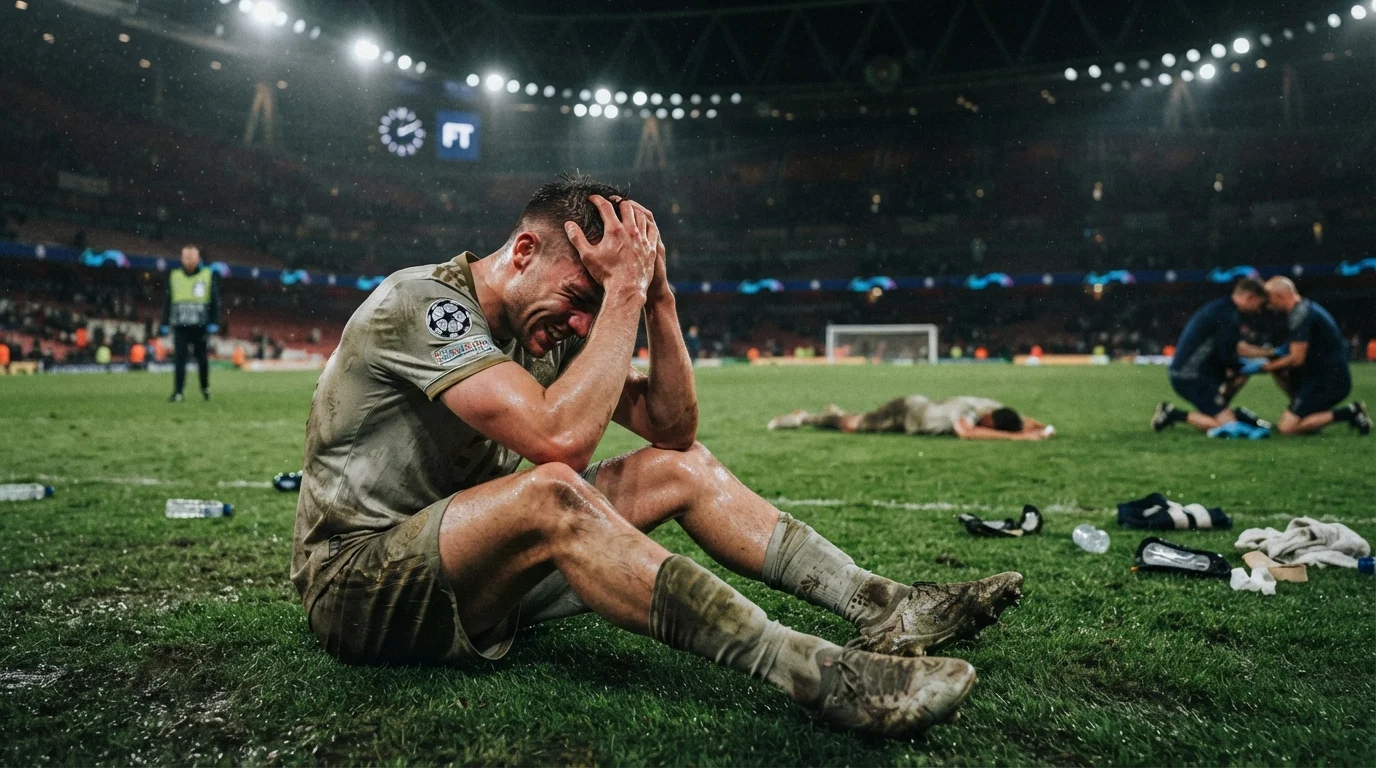
Complaints about the fixture list are as old as professional football, and for a long time they were treated as managers making excuses. The science has since caught up with them. Playing a full match every three or four days puts a footballer’s body through a cycle it cannot fully complete, and the effects show up in performance, in injuries and in the results table.
Understanding why means looking at what a match actually does to a player, and how long it takes to undo.
What does ninety minutes do to the body?
More than most people assume from watching.
A top-flight outfield player covers somewhere around ten to thirteen kilometres in a match, but distance is the least demanding part. What really takes its toll is the repeated high-intensity work: sprints, sudden changes of direction, jumps, tackles and decelerations. Each hard stop puts significant load through the muscles of the legs, and a player does hundreds of them in a game.
That work causes small amounts of damage in the muscle fibres, drains the energy stores in the muscles, and leaves the nervous system fatigued. None of it is dangerous in itself. It is exactly what training is designed to prepare players for. The problem is how long the body needs to repair it.
How long does recovery actually take?
Longer than the gap between many fixtures.
Research on footballers generally suggests that full recovery of muscle function, energy stores and the markers of muscle damage takes somewhere in the region of seventy-two hours, and sometimes longer after a particularly intense match. Some measures return to normal quickly. Others lag behind well into the third day.
Now set that against a fixture list with a Saturday match, a Tuesday match and another on Saturday. The player starts the second match before he has fully recovered from the first, and the third before he has recovered from the second. Each game begins from a slightly lower starting point than the last, which is why fatigue accumulates across a busy period rather than simply appearing in one match.
Does congestion really cause more injuries?
The evidence points that way, particularly for muscle injuries.
When players are asked to perform at full intensity on muscles that have not fully repaired, the risk of strains rises. Hamstring injuries in particular tend to follow periods of heavy fixtures, because the hamstrings do so much work during sprinting and deceleration and are especially vulnerable when fatigued.
The pattern is not that every busy week produces injuries. It is that the odds tilt. A squad playing twice a week for a month will usually lose more players to muscle problems than one playing once a week, and the players lost are often the ones who have been playing every game.
Why do tired teams concede late goals?
Because fatigue shows up first in the things that decide matches in the final fifteen minutes.
A tired player does not suddenly stop running. What goes first is sharpness: the speed of the first step, the concentration needed to track a runner, the decision to close down or hold position. Sprint speed drops slightly and recovery runs arrive a fraction later.
Those small declines matter most at the end of games, when both teams are tired and the one with slightly more left tends to find the space. This is why a side that has played three times in a week so often concedes in the closing stages against a fresher opponent.
How do clubs manage it?
Rotation is the obvious answer, and it works, but it has limits.
A club with a deep squad can change several players between matches, giving each one more time to recover. The limit is quality. Every change weakens the side slightly, and a manager must decide whether a tired first-choice player is still better than a fresh deputy. Often the answer is yes, which is why the best players tend to play the most matches and carry the most fatigue.
Recovery work fills the gaps. Clubs now plan the days between matches in detail, with sleep, nutrition, cold water immersion, massage and light active sessions all aimed at speeding up repair. Training on those days is usually gentle, because the priority is getting ready for the next game rather than building fitness.
Does it affect some positions more than others?
Yes, and it shapes how managers rotate.
Central midfielders and full-backs tend to cover the most ground and do the most repeated high-intensity running, so they carry the heaviest load. Centre-backs cover less distance but do a lot of jumping and short, sharp movements. Goalkeepers are the least affected physically, which is why they are rotated far less.
Wide attackers sit somewhere in between, doing fewer total runs but a high proportion of flat-out sprints. Their fatigue shows up in reduced top speed, which is exactly the quality they are picked for.
Can players train their bodies to cope better?
To a degree, and fitness is the first line of defence.
A player with a high aerobic base recovers faster between sprints within a match and between matches across a week. This is why so much pre-season work goes into building endurance. It does not stop fatigue, but it raises the level a player can sustain before fatigue starts to cost him, and it shortens the time he needs to bounce back.
Strength work helps too, particularly on the muscles that take the heaviest load. Stronger hamstrings and a stronger core are more resistant to the strains that tend to follow busy periods, which is why injury prevention now sits alongside fitness in most clubs’ training programmes.
Why is it getting harder?
Because the season keeps getting fuller and the matches keep getting faster.
Competitions have been expanded, international breaks add travel, and summer tournaments have shortened the time players get to recover between seasons. At the same time, the game has become more intense, with more pressing and more high-speed running than it had a generation ago. Players are doing more demanding work in each match and getting less time between them. BBC Sport’s football coverage regularly reports on the wider debate about player welfare and the calendar, which has become one of the biggest arguments in the modern game.
What it means when you watch
Next time a strong side drops points midweek, or concedes late away from home after a run of fixtures, fatigue is a reasonable first suspect. The team may not look tired in any obvious way. The damage is in the details: the slightly late press, the run not tracked, the tackle arriving a fraction slow.
Heat adds another layer to all of this, and our piece on how weather and heat change the way football is played covers what happens when fatigue meets a hot afternoon. The kit plays its part too, and our breakdown of how football kit fabric actually works explains how modern shirts help players cope with the work.
Frequently asked questions
How long does it take a footballer to recover after a match?
Full recovery of muscle function and energy stores is generally thought to take around seventy-two hours, and sometimes longer after an especially intense game. Some measures recover faster than others.
Does playing more matches cause more injuries?
The evidence suggests the risk of muscle injuries rises during congested periods, particularly hamstring strains, because players perform at full intensity on muscles that have not fully repaired.
Why do managers rotate their squads?
To give players more time to recover between matches. The trade-off is quality, since every change weakens the side slightly, so managers balance freshness against playing their strongest team.