

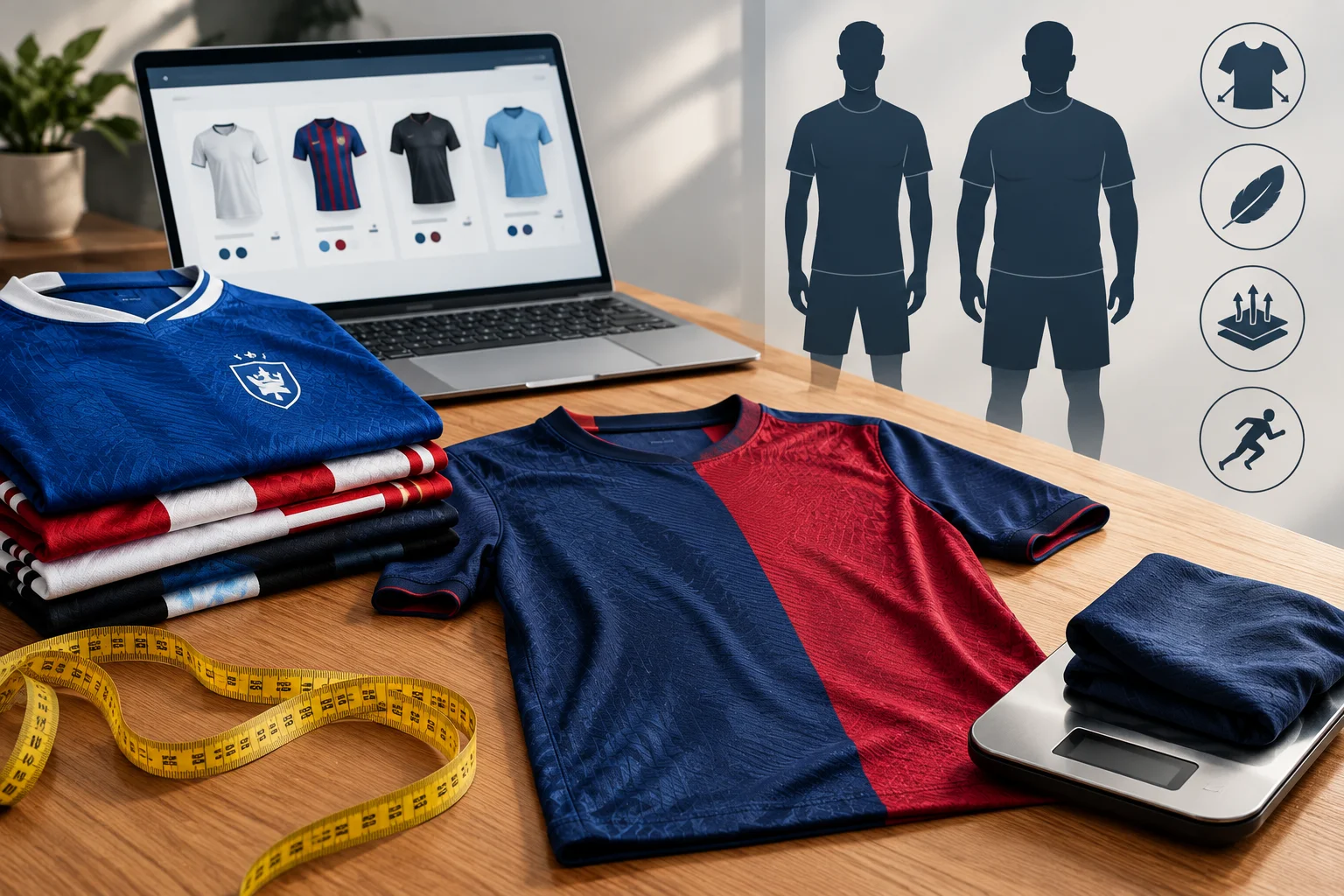
Most kit descriptions tell you very little. A listing will mention moisture management and a slim cut, give you a size chart, and leave it there. What it will not tell you is the thing that actually determines how a shirt feels in the seventieth minute: how much it weighs, how it is cut across the shoulder, and how much it changes shape once it is wet.
Those three properties are measurable, they vary a lot between kits, and they are the reason two shirts made from similar fabric can behave completely differently. If you are buying football kits online and you want something you will actually play in rather than just wear, they are worth understanding.
What a shirt’s weight really means
A modern match shirt weighs somewhere between 120 and 180 grams in a medium. That sounds like a trivial range, and dry it is. Wet, it is not. A loosely woven shirt can take on two or three times its own weight in sweat and rain, while a tightly knitted one holds far less, because there is less space inside the structure for water to sit.
This is why weight on the hanger is a poor guide. The number that matters is how much water the fabric retains after it has been saturated, and lighter fabrics are not automatically better at this. A very thin, open knit feels featherlight in a shop and becomes heavy and clingy in a downpour. A slightly denser fabric with a tighter face often stays closer to its dry weight.
For a replica worn to a match or down the pub, none of this matters much. For a shirt you will run in twice a week, it is the single biggest difference between something you forget you are wearing and something you spend the second half pulling away from your chest.
Cut: where the fabric is allowed to move
Fit is usually described in one word — slim, regular, athletic — which covers up most of what is going on. The useful detail is where the shirt is shaped and where it is not.
A well-cut playing shirt is narrower through the waist than the chest, slightly longer at the back than the front, and has a sleeve set forward rather than straight out from the shoulder. That forward set is the part people notice without being able to name it. It means the sleeve does not drag across the shoulder joint when the arm comes up, which is what causes that tight pull across the upper back when you reach for a header in a cheaper shirt.
Panelling does the same job in a different way. Side panels made from a stretchier fabric than the front and back let the torso expand with breathing while keeping the main body stable, so the shirt does not ride up. Cheap reproductions skip the panels and use one fabric throughout, then compensate by cutting the whole thing looser.
Why do player versions fit so differently?
Because they are designed around a body that trains every day, and around the assumption that the shirt will be worn for ninety minutes and then taken off. Player-issue kit is cut closer, often shorter in the body, and uses a lighter, more aggressively engineered fabric with bonded rather than stitched seams.
That makes it excellent on the pitch and uncomfortable for most people off it. If you are between sizes and buying a player version, size up. If you want something to wear casually, the standard replica is the better garment, and it is not a compromise — it is a different brief. We go into the construction differences in more detail in our comparison of player version and replica shirts.
Shorts and socks matter more than people expect
Shirts get all the attention, but the two items that cause most discomfort are the shorts and the socks. Shorts that are cut too narrow through the thigh restrict stride length, which you feel as fatigue rather than as tightness. Shorts with a flat drawcord and a bonded waistband stay put; ones with a bulky elastic band roll over and chafe.
Socks are the part where the spec genuinely varies. A good playing sock has a dense, cushioned foot, a thinner leg so it fits inside a shin pad, and a ribbed calf that holds without cutting in. A cheap one is uniformly thin, which means no cushioning under the studs and a calf that slides down over the course of a game. If you only upgrade one part of a kit, upgrade the socks.
Badges and printing affect comfort more than you would think
The last variable is the one nobody lists. A club crest can be embroidered, heat-pressed as a thin transfer, or applied as a thick rubberised patch, and the three feel completely different against the skin. Embroidery is the most durable and the least breathable, because the stitching closes off the fabric behind it. A thin heat transfer is the lightest option and the one most likely to crack after repeated washing. A heavy rubberised badge stiffens a panel of the chest permanently.
Name and number printing does the same thing on a larger scale. A full set of numbers in a thick vinyl covers a good portion of the back, which is the area that needs to breathe most, and on a cheap shirt you can feel the difference within fifteen minutes of running. Shirts intended for play use thinner, more flexible transfers for exactly this reason. If you are buying a shirt to wear rather than to play in, none of this is a problem — but it is worth knowing that the heaviest-looking badge is not a sign of quality.
How can you judge fit when buying online?
You cannot try it on, so you have to measure. Take a shirt you already like, lay it flat, and record three numbers: chest width from armpit to armpit, body length from the centre of the collar to the hem, and sleeve length from the shoulder seam. Compare those to the seller’s measurements, not to the size letter, which means different things at different brands and in different countries.
Then read the fabric description for two specific things: whether the fabric has any stretch, and whether the shirt uses more than one fabric. A listing that says nothing about either is usually describing a single-fabric garment with a generous cut. That is fine for casual wear and limiting for play.
Finally, check the washing guidance. Technical fabrics lose their moisture handling quickly if they are washed hot or dried on a radiator, and a kit that has been treated badly will feel like a cotton shirt within a season. Our guide to football kit fabrics covers what the various fabric names actually refer to.
Frequently asked questions
Is a lighter football shirt always better?
No. Very light fabrics are usually open knits, which hold more water once saturated. A slightly heavier shirt with a tighter face often stays drier and more stable in wet conditions.
Should I buy a player version to play in?
If it fits you, it is the better playing garment — closer cut, lighter, with bonded seams. But it is sized for an athlete’s body, so order a size up unless you are certain, and expect it to be less comfortable off the pitch.
Does sizing differ between brands?
Significantly. The same nominal size can vary by several centimetres across the chest between manufacturers and between a club’s home and third shirt in the same season. Always work from measurements.
How long does the moisture handling last?
With cool washes, no fabric conditioner and air drying, a good shirt holds its properties for several seasons. Hot washes and tumble drying can degrade them noticeably within months. Getting the basics right before a match matters too, which is where what a footballer’s warm-up is actually doing comes in.