

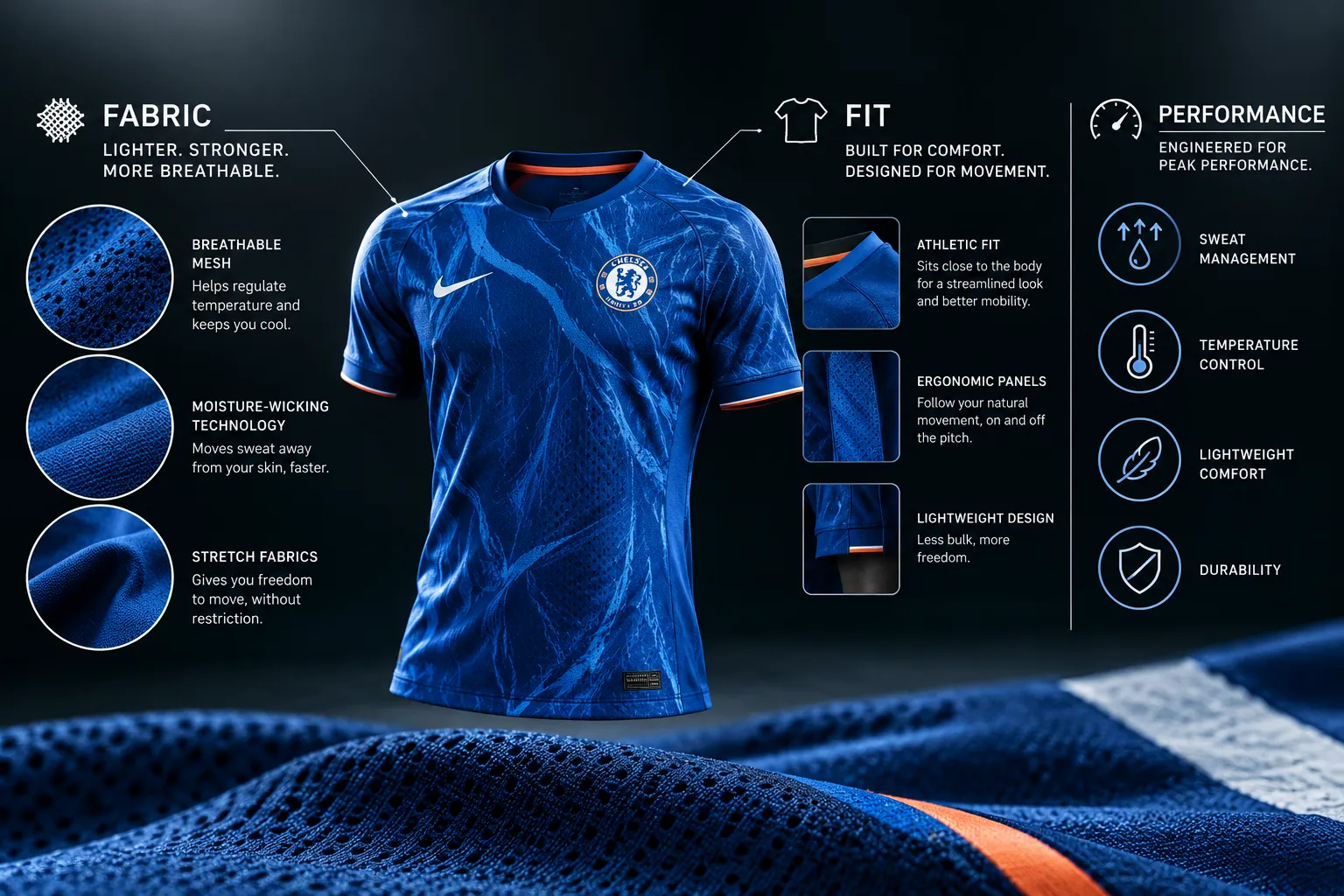
A modern football shirt weighs less than a paperback and costs more than most of the clothes in your wardrobe. The gap between those two facts is where all the interesting engineering sits. A shirt that performs is not simply a thinner version of a cotton t-shirt — it is a knitted structure designed to move water in a particular direction, cut to allow a specific range of movement, and built so that the seams do not fail where the load is highest.
Very little of that appears in a product description, which tends to stop at “moisture-wicking” and a size chart. This guide is the overview: what the fabric actually is, how it handles sweat, why fit matters as much as material, where construction fails, and what the differences between kit tiers really amount to. Each section links to the detailed piece on this site, so you can go as deep as you want.
What a modern football shirt is actually made of
Almost all of it is polyester, and increasingly recycled polyester spun from reclaimed plastic. That sounds unglamorous and is the whole point: polyester is hydrophobic, meaning the fibre itself does not absorb water, which is exactly what you want in a garment that will be soaked in sweat for ninety minutes.
The behaviour comes from the structure rather than the raw material. The yarn is extruded with channels or lobes along its length, knitted into a fabric with a deliberate difference between the inner and outer face, and finished with a treatment that makes the outer surface attract water while the inner stays repellent. That combination pulls moisture off the skin and spreads it across the outside, where it can evaporate.
Small amounts of elastane are added in specific panels for stretch, and the knit itself is varied across the garment — tighter where the shirt needs to hold its shape, more open where it needs to breathe. Our breakdown of what the fabric names actually mean decodes the marketing terms, and the science inside a Premier League shirt goes further into the construction.
How a fabric moves sweat, and why it stops
The mechanism is capillary action. Water travels along the channels in the fibre and through the gaps between them, from the saturated inner face towards the drier outer one, then spreads over a larger surface area so that it evaporates faster. A good fabric does this fast enough that the shirt never becomes heavy.
Three things break it. The first is fabric conditioner, which coats the fibres and destroys the surface chemistry the whole system depends on — a few washes with conditioner and a technical shirt behaves like cotton. The second is heat: hot washes and tumble drying degrade both the finish and the fibre. The third is simply time and abrasion, which flattens the channels.
This is why a shirt that performed beautifully in its first season can feel clammy in its third, with nothing visibly wrong with it. The care matters more than the original specification, and most shirts are ruined in a laundry basket rather than on a pitch.
Why does fit matter as much as fabric?
Because a fabric only moves water where it is in contact with skin. A shirt that billows away from the body in the middle of the back leaves the sweatiest area of the torso with nothing touching it, and the best fabric in the world cannot wick from a gap.
That is the real argument for a closer cut, and it is a performance argument rather than an aesthetic one. Fit also governs where a shirt restricts movement: a sleeve set straight out from the shoulder drags across the joint when the arm goes up, while one set slightly forward does not. Side panels in a stretchier knit let the torso expand with breathing while the main body stays stable.
Weight interacts with all of it. A very light, open knit feels featherlight dry and holds a surprising amount of water once saturated, while a slightly denser fabric with a tighter face often stays closer to its dry weight in the rain. Our guide to how fit and weight change the way a shirt performs works through the trade-off, and what to check on a cheaper Tottenham kit shows what gets cut when the price comes down.
Construction: seams, panels and the parts that fail
Seams are where shirts break, and the method matters. A stitched seam is strong, cheap and creates a raised ridge that can chafe under a strap or an arm. A bonded seam — fabric joined with adhesive and heat rather than thread — is flatter, lighter and has no stitch holes, which removes a channel for water and a line of weakness, but it is more expensive and less tolerant of repeated hot washing.
Panelling is the other structural decision. A shirt built from several fabrics, each chosen for the demands of its zone, performs better than a single-fabric garment and costs considerably more to make. The first corner a budget shirt cuts is to use one fabric throughout and compensate with a looser cut.
Applied elements add their own problems. A heavy rubberised badge stiffens a panel permanently; a thick vinyl number covers the part of the back that most needs to breathe. Our look at how a modern Arsenal shirt is constructed takes one shirt apart section by section.
What do you actually get from a player version?
A different garment, not a better-finished version of the same one. The authentic or player shirt is cut closer, made from a lighter engineered knit with ventilation worked into the structure rather than added as mesh panels, and assembled with bonded seams.
All of that is designed around a body that trains daily and a garment that will be worn for ninety minutes and then removed. Off a pitch it is less comfortable than the replica, and it runs at least a size small through the chest and short in the body. The replica is not a compromised version of the player shirt — it is built to a different brief, and for anything other than playing it is the better product.
Our side-by-side comparison of the player version and the replica sets out what changes between the two, and why football kits cost what they do explains how much of the price gap is engineering and how much is licensing.
Training kit and match kit are built for different jobs
Match kit is optimised for ninety minutes at high intensity in front of cameras. Training kit is optimised for six sessions a week, repeated washing, variable weather and no broadcast requirement at all — which means it is often the more practical garment, and it is almost always cheaper because it carries no competition patches or sponsor arrangement.
The construction differences follow from the use. Training tops tend to use slightly heavier, more durable knits, with fewer bonded seams and more generous cuts, and they frequently include features a match shirt would never carry: thumbholes, zipped necks, pockets. If you actually exercise, a set of football training kit is a better buy than a replica match shirt at the same price.
We compare the two directly in training kit versus match kit, including which features are worth paying for.
Colour, heat and what a dark shirt hides
Colour is not a neutral choice. Dark fabrics absorb more solar radiation than light ones, which raises the surface temperature of the shirt measurably in direct sun, and that is a real consideration for teams playing afternoon fixtures in hot conditions.
Dark shirts also behave differently when wet. A saturated patch is far less visible on a dark fabric than on a white one, which flatters the garment while telling the player nothing, and dye choice affects how evenly the colour fades over a season. Solution-dyed yarn, where pigment is added before the fibre is extruded, holds colour far better than surface-dyed fabric — one of the quieter differences between a premium shirt and a cheap one.
Our piece on what a dark Liverpool shirt hides covers the practical side, and for two case studies in how a club’s colour becomes an engineering constraint, see Manchester City’s sky blue and Brighton’s kit evolution. The most famous example of colour as a design decision rather than a technical one remains Arsenal’s bruised banana away shirt.
Why is children’s kit a harder engineering problem?
Because children sweat differently, grow unpredictably, and treat kit far worse than adults do. Thermoregulation in children is less efficient than in adults — a higher surface-area-to-mass ratio and a lower sweat rate mean they heat up faster and cool down more slowly — which makes breathability more important in a child’s shirt than in an adult’s, not less.
In practice, children’s ranges are produced at the entry tier only, with one fabric and a simple cut, which is the opposite of what the physiology argues for. Sizing makes it worse: kit is sold by age, age labels vary enormously between suppliers, and a shirt bought a size small is a shirt that restricts movement in exactly the conditions where ventilation matters most. Our guide to kids’ football shirt sizing and fabric covers how to buy around the problem.
What the kit has to cope with
The shirt is the easy part of the system. The player inside it is managing fatigue, heat, fluid loss and a fixture calendar that does not allow full recovery, and most of what limits performance has nothing to do with what they are wearing.
If you want the physiology rather than the garment, the rest of this site covers it. On load and recovery: fixture congestion and player fatigue, sleep and recovery in professional football, and why players lose sharpness after an international break. On the environment: how heat and weather change football and what players actually drink.
On preparation and injury: what a footballer’s warm-up is actually doing, why hamstring injuries dominate football, and how GPS tracking changed training. And on how the rules have adapted to all of it, how five substitutes changed football. Kit specifications for European competition are published by UEFA.
Frequently asked questions
Is a lighter football shirt always better?
No. Very light fabrics are usually open knits, which hold more water once saturated. A slightly heavier shirt with a tighter outer face often stays drier and more stable in wet conditions.
Why should I never use fabric conditioner on a football shirt?
Conditioner coats the fibres and destroys the surface treatment that makes the fabric move sweat away from the skin. A few washes with it can permanently reduce how the shirt performs.
Do bonded seams last as long as stitched ones?
Under normal use, yes, and they are flatter and lighter. They are less tolerant of hot washing and tumble drying than stitched seams, so a bonded shirt needs more care.
Does the colour of a shirt affect the player?
Measurably, in direct sun dark fabrics absorb more solar radiation and reach a higher surface temperature than light ones. In cool or overcast conditions the difference is negligible.