

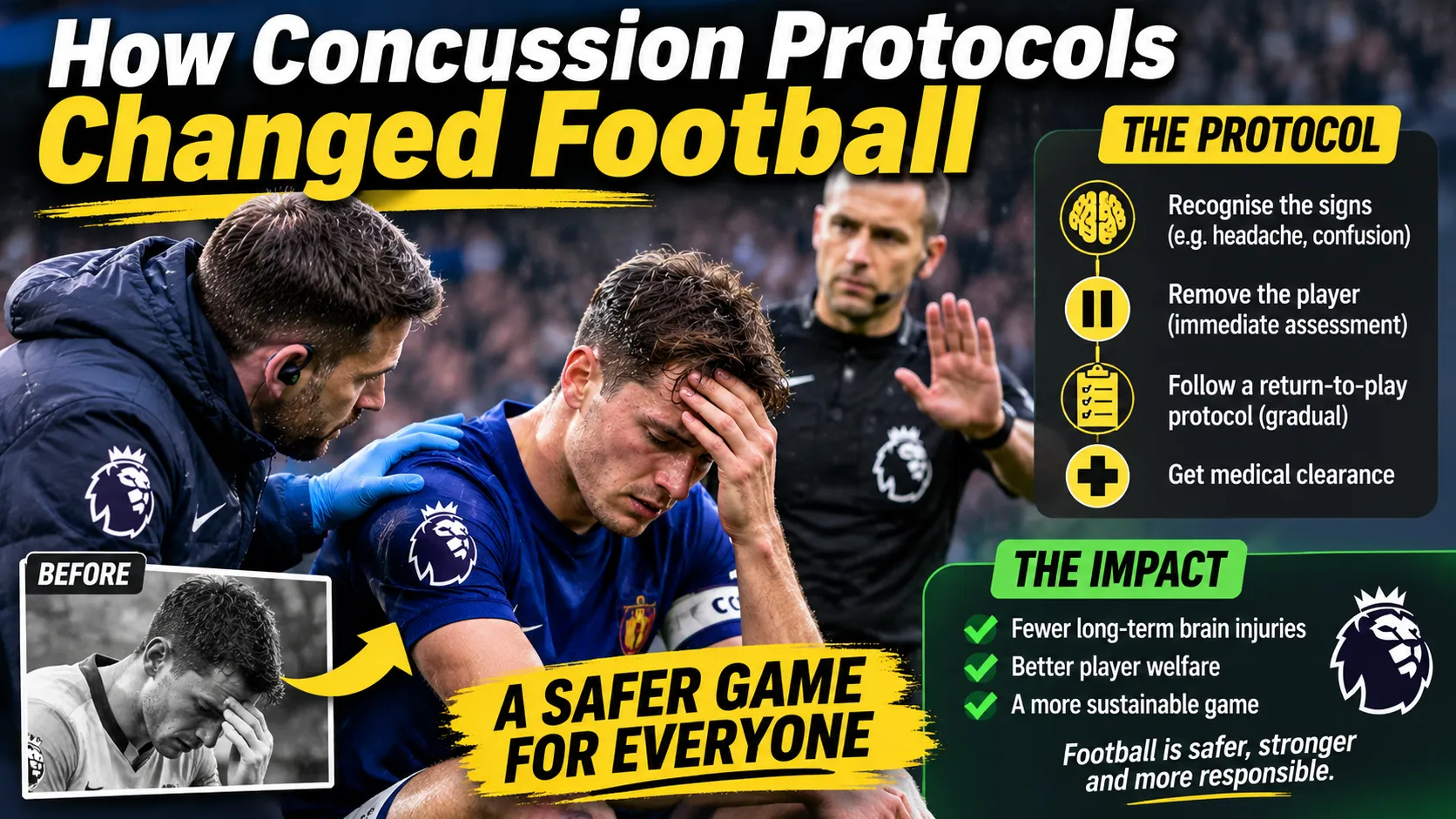
For most of the game’s history a head injury was a thing to be shaken off. A player who was knocked out might be back on within minutes, smelling salts and a sponge counting as treatment, and the suggestion that this was dangerous would have been treated as softness.
That has changed more than almost any other aspect of football medicine, and it changed because the evidence became impossible to argue with. The current protocols are not perfect and parts of them are genuinely contested, but the direction has been one-way.
What the old approach actually was
No approach at all, in any formal sense. Diagnosis was made on the touchline by whoever was there, in seconds, with no agreed criteria and enormous pressure to return the player to a match his side was trying to win. The player himself was frequently consulted, which is close to the worst possible source given that impaired judgement is a symptom.
The consequences were twofold. Immediate risk: a player returning to the pitch concussed is at considerably higher danger from a second impact before the first has resolved. And cumulative risk, which took much longer to establish and turned out to be the more significant of the two.
What did the evidence actually show?
The turning point for football specifically was research into long-term outcomes among former professionals. Work out of Glasgow comparing former Scottish professional footballers with the general population found a markedly higher rate of death from neurodegenerative disease a finding substantial enough that it could not be explained away, and one that landed in a sport which had spent decades insisting there was nothing to see.
Two things followed. Protocols for managing acute head injury were tightened, and attention turned to repetitive head impacts that are not concussions at all the ordinary business of heading a ball thousands of times across a career.
That second strand is the harder one, because it implicates a normal part of the game rather than an accident within it.
The current acute protocol
The governing principle is stated simply: if there is any suspicion of concussion, the player is removed and does not return that day. Not assessed and returned, not given a few minutes removed, permanently, for that match.
That sounds obvious and it required a rule change to make workable, because a side forced to lose a player to a head injury had an incentive to understate it. Permanent additional substitutions for suspected concussion were trialled and then adopted, so that removing a player no longer costs the team a change it would otherwise have used. Decisions sit with the medical staff rather than the manager, and in many competitions the final call cannot be overridden from the bench.
What follows is a graduated return to play: a staged progression over a number of days from rest, through light aerobic work, to non-contact training, to full contact, with each stage only begun if the previous one produced no symptoms. If symptoms return, the player goes back a stage. The FA publishes the current guidance and the stage-by-stage protocol.
Why is heading in training now limited?
Because the cumulative exposure is where the volume is. A player might head the ball a handful of times in a match and many times that in a week of training, which makes training the obvious place to reduce total impacts without changing the game itself.
Guidance now recommends limits on higher-force headers in a training week for adult professionals, with tighter restrictions through the youth age groups and heading removed entirely from the youngest. The logic is straightforward: reduce the dose where it is cheapest to reduce.
It is also where the resistance sits, because heading is a skill and a skill needs practice. The counter-argument from coaches is that a player who heads the ball less in training will head it worse in a match, and may consequently take more awkward impacts. That tension has not been resolved, and reasonable people in the game disagree about where the line should fall.
Where the amateur game sits
The professional protocols are only as good as the infrastructure behind them, and below the professional game almost none of that infrastructure exists. There is no doctor on the touchline, often no permanent concussion substitute available under the competition rules, and nobody whose job it is to prevent a player talking their way back on.
That inverts the usual relationship between level and caution. Recreational football is where the protocols need to be strictest, because the margin for error is largest and the support is smallest and it is where they are applied least consistently.
Grassroots guidance acknowledges this by being deliberately more conservative than the elite version: a longer minimum stand-down, a requirement for medical clearance before contact, and an explicit instruction that nobody returns the same day. It is written to be followed by a parent with no medical training, which is the right design brief.
What is still disputed
Several things, and it is worth being clear about them. The strength of the link between heading specifically and long-term outcomes is still being established the association between a professional football career and elevated neurodegenerative risk is firmer than the mechanism behind it.
Whether current protocols are applied consistently is a separate and more practical criticism. Assessments made in a stadium, under time pressure, by staff employed by one of the teams, are structurally difficult, and there have been high-profile cases where a player plainly should have been removed and was not.
And the amateur game is where the protocols are weakest, because there is no doctor, no permanent substitute available in many competitions, and nobody to enforce a graduated return. Recovery after any kind of load is the part amateurs underestimate most, which we cover in sleep and recovery in football.
What a player or parent should actually do
The guidance for the recreational game is deliberately more conservative than the professional version, for the obvious reason that there is no medical support. If a head impact is followed by any symptom at all confusion, headache, dizziness, nausea, memory gaps, feeling “off” the player comes off and does not go back on that day, regardless of how well they say they feel.
After that it is a graduated return under the guidance above, and a medical opinion before returning to contact. The single most important point is that the player is not the right person to make the call, and a coach who asks “are you alright to carry on” is asking the wrong question of the wrong person.
For a related example of evidence slowly reshaping routine practice, our piece on what a footballer’s diet actually looks like covers an area where the science arrived long before the habits changed.
Frequently asked questions
Can a concussed player return to the same match?
No. Current protocols require permanent removal if concussion is suspected, and additional substitutions exist so that removing the player does not cost the team a change.
How long before a player can play again?
A graduated return over a number of days, progressing only while each stage produces no symptoms. The timeline depends on the individual, not on the fixture list.
Is heading being banned?
Not in the adult game. Guidance limits higher-force headers in training and removes heading entirely for the youngest age groups, on the basis that training is where most impacts occur.
Who decides whether a player comes off?
Medical staff, not the manager and not the player. In many competitions the decision cannot be overridden from the bench.