

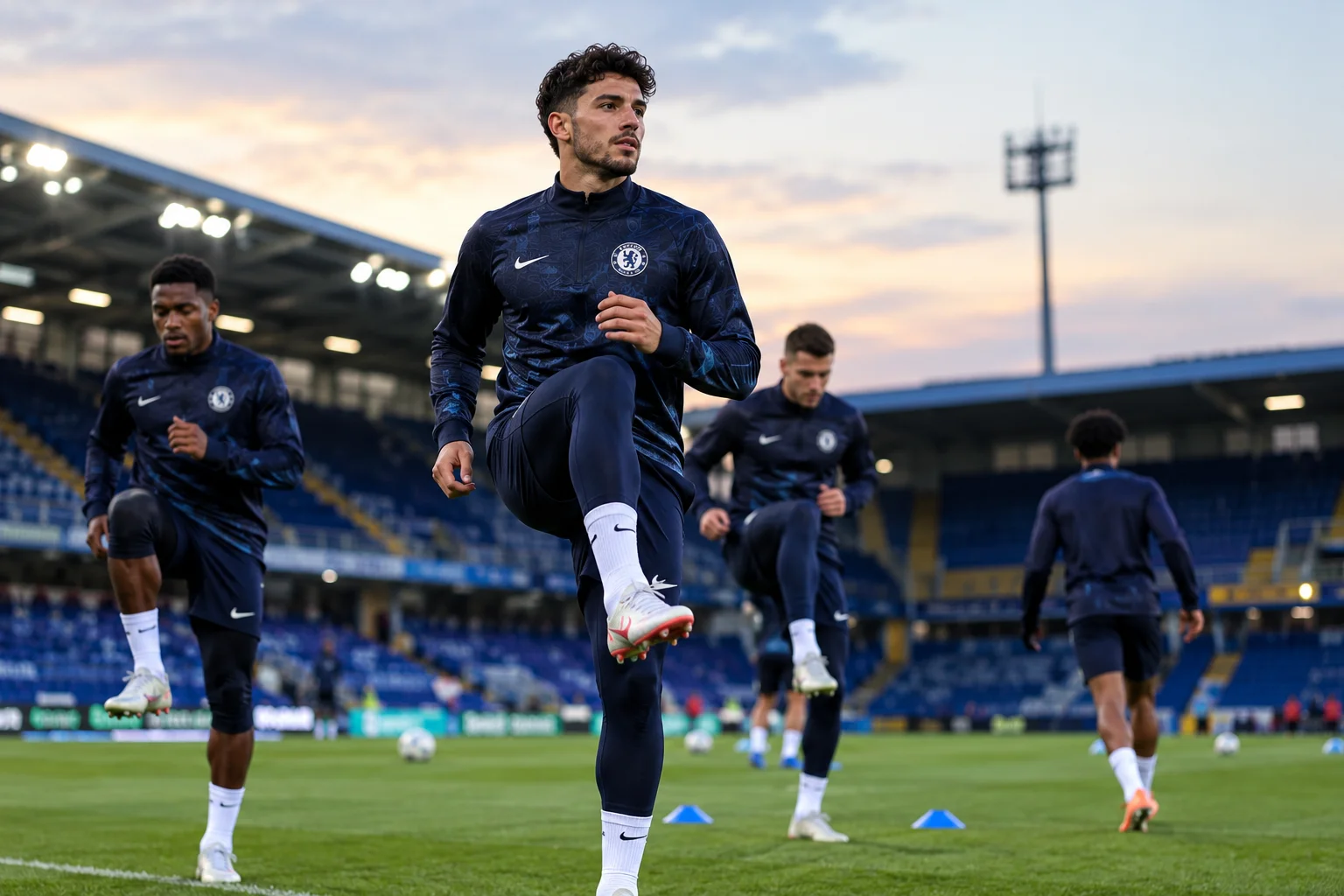
The pre-match warm-up is the most watched part of football that nobody watches. Supporters arrive during it, players go through it in front of a half-empty stadium, and most people assume it is there to loosen muscles up. That is a small part of it, and not the most important.
A properly built warm-up is doing four separate jobs at once: raising muscle temperature, waking up the nervous system, rehearsing the specific movements the player is about to perform, and reducing the chance of a soft-tissue injury in the opening twenty minutes. Each of those requires something different, which is why the sequence looks the way it does.
Why does muscle temperature matter?
Muscle performs better warm. Raising muscle temperature by two or three degrees increases the speed at which fibres contract, lowers the resistance inside the tissue, and makes the muscle more tolerant of being stretched quickly — which is exactly what happens when a player sprints or lunges.
That is why the first phase is always light running rather than stretching. Stretching a cold muscle does nothing useful and may reduce its ability to produce force for a short period afterwards. The jogging comes first because everything that follows depends on the tissue being warm enough to handle it.
The effect does not last long. Muscle temperature falls back towards baseline within about fifteen minutes of stopping, which is why the gap between the end of the warm-up and kick-off matters, and why substitutes who sit for an hour and then come on cold are at a measurably higher risk of injury.
Waking up the nervous system
The second job is neural rather than muscular. Sprinting, jumping and changing direction all depend on how quickly the nervous system can recruit muscle fibres, and that readiness improves with a small amount of high-intensity work shortly beforehand.
This is the phase of strides, accelerations and short jumps you see in the final ten minutes before players go back in. It is deliberately brief and deliberately hard. The aim is not to tire anyone out but to make sure the first explosive action of the match is not also the first explosive action of the day, which is when hamstring injuries cluster.
Why does the warm-up include so much movement work?
Because static stretching does not prepare a player for football. Holding a hamstring stretch for thirty seconds increases range of movement temporarily but can reduce power output for up to half an hour, which is the opposite of what you want before kick-off.
Modern warm-ups use dynamic movements instead — lunges, leg swings, controlled rotations, hip openers — which take joints through the range they will need under light load. The muscle gets lengthened while it is working rather than while it is relaxed, which prepares it for the way it will actually be used. Static stretching still has a place, but it belongs after the session, not before it.
The half-time problem
The warm-up has a second act that gets almost no attention. Muscle temperature falls back towards resting levels within about fifteen minutes of activity stopping, and a half-time interval is precisely long enough to undo most of what the pre-match work achieved. Players come out for the second half cooler, stiffer and slower to accelerate than they were when they went in.
This is why the pattern of injuries within a match is not flat. Soft-tissue problems cluster in the opening minutes of each half, and the second-half cluster is the one caused by sitting down. Clubs now manage the interval deliberately: a short re-activation before going back out, heated jackets or passive warming garments in cold weather, and a strong preference for keeping players moving rather than talking tactics for the full fifteen minutes.
Amateur football does the opposite almost universally. A team that spends the whole interval standing still with a cup of squash and then kicks off at full intensity is taking on an avoidable risk, and it does not take much to fix. Two minutes of jogging and a few strides before the restart recovers most of the lost temperature.
Injury prevention, and how much it actually helps
The clearest evidence in this area comes from structured programmes designed to be done before training rather than before matches. The best known is FIFA’s 11+ routine, a sequence of running, strength, balance and landing exercises. Trials across amateur and youth football have repeatedly found meaningful reductions in injury rates among teams that complete it consistently, with the largest effects on knee and hamstring problems. FIFA has published the protocol freely for exactly that reason.
The word doing the work there is consistently. The programmes that reduce injuries are the ones performed two or three times a week over months, not the ones done before a cup tie. For a recreational player, twenty minutes twice a week of that sort of work is more valuable than anything they do in the ten minutes before kick-off.
The parts specific to the position
Once the general work is done, warm-ups diverge. Goalkeepers do handling, footwork and a graded set of dives, because their first action may be a full-stretch save and there is no gentle version of that. Centre-backs do heading and jumping. Forwards do finishing at increasing intensity, which serves a technical purpose as much as a physical one.
This specificity matters because the nervous system prepares for patterns, not for exercise in general. A striker who has rehearsed striking a ball cleanly ten times is better placed than one who has only jogged, even if their muscle temperature is identical.
What happens if a player skips it
Nothing, usually, which is why it is easy to get lazy about. The cost shows up as a probability rather than an event. A player who regularly starts cold will, over a season, pick up more minor muscle injuries than one who does not, and will perform slightly worse in the first fifteen minutes.
At the elite level the margins are small enough to matter. At amateur level they are larger, because the players are less conditioned, the pitches are worse and there is no medical staff to manage the consequences. The irony is that the people who skip the warm-up most often are the ones it would help most. Fatigue later in the week compounds the same problem, as our piece on fixture congestion and player fatigue explains.
Frequently asked questions
Should I stretch before playing football?
Not statically. Use dynamic movements that take your joints through their range while the muscles are working. Save held stretches for after the game, when they help with range of movement and feel better.
How long should a warm-up last?
Fifteen to twenty-five minutes for a competitive match, built as light running, dynamic movement, then short bursts of high intensity. Finishing within ten minutes of kick-off matters, because muscle temperature drops quickly.
Do substitutes need to warm up again?
Yes, and they should keep moving while waiting. A player who has been sitting for an hour has lost most of the benefit of the original warm-up and faces a higher injury risk in his first few sprints. That risk rises further when squads are rotated heavily, which is the subject of how five substitutes changed football.