

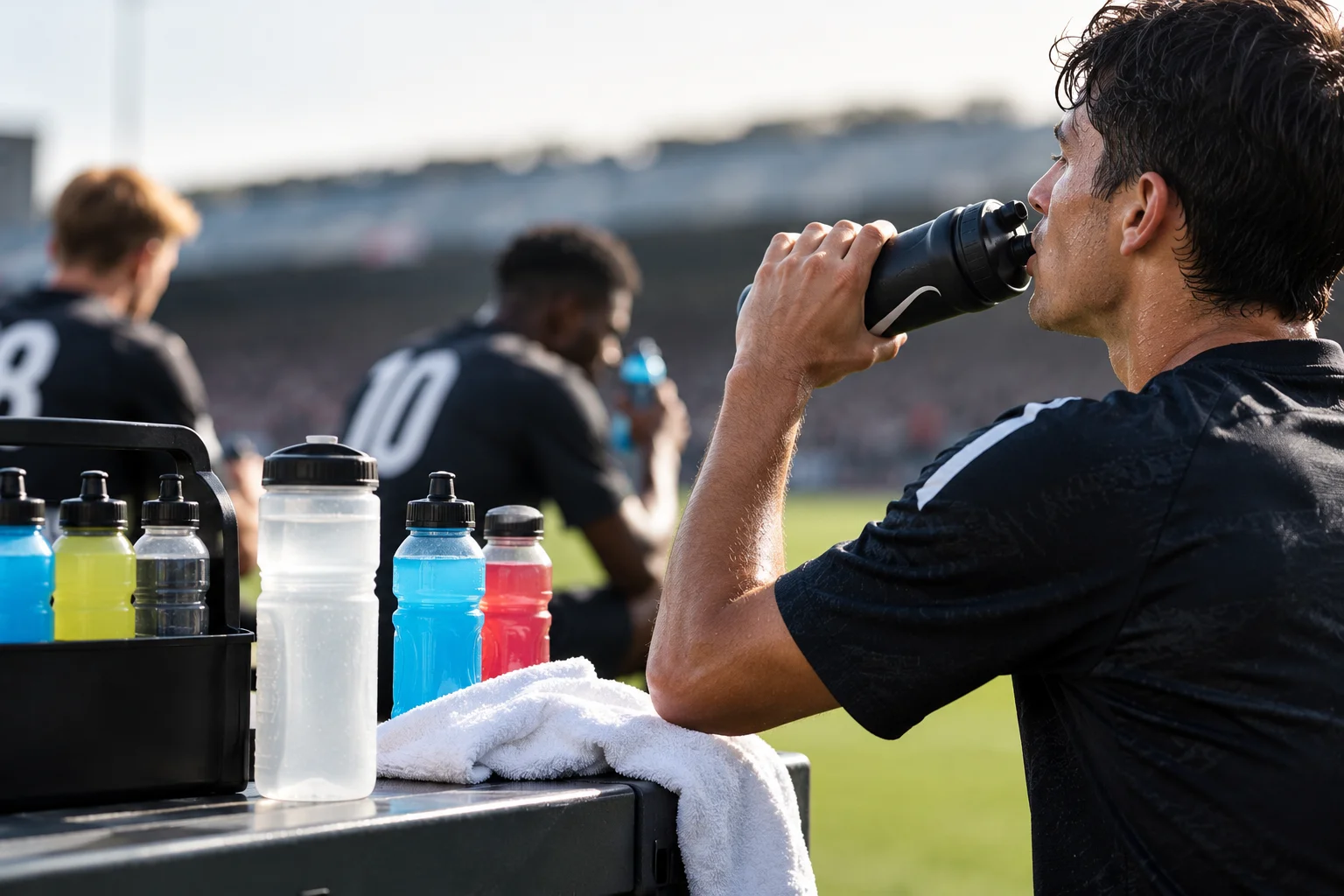
A professional footballer can lose a considerable amount of fluid over ninety minutes, and even modest dehydration measurably reduces performance. Sprint speed drops, decisions slow, and the ability to sustain effort in the final quarter of a match declines. Clubs now treat hydration as a planned part of match preparation rather than something players manage for themselves.
This is what the science says, what clubs actually do, and what it means for anyone playing at any level.
How much fluid does a match take?
It varies enormously, and that variation is the first thing clubs measure.
Sweat rates differ between players by a factor of two or more, depending on body size, fitness, position and how hard an individual works. The same player will sweat far more on a warm August afternoon than on a cold evening in January. A midfielder covering twelve kilometres loses more than a centre-back covering nine.
Clubs establish each player’s sweat rate by weighing them before and after training sessions in different conditions. That number, rather than a general rule, determines how much each player is told to drink.
What happens when a player is dehydrated?
Performance declines before the player feels thirsty.
The body’s cooling system depends on blood volume, and as fluid is lost that volume falls. The heart works harder to deliver the same effort, core temperature rises faster, and the muscles receive less of what they need. Research consistently shows reductions in sprint performance, in repeated high-intensity running and in decision-making accuracy at levels of dehydration that players themselves do not notice.
The effect compounds with fatigue. A dehydrated player tires sooner and recovers more slowly between efforts, which is why the final twenty minutes of a hot match so often belong to the side that managed fluid better.
What do players drink before a match?
Water mostly, timed to arrive hydrated without needing the toilet at kick-off.
Players are encouraged to drink steadily through the day before a match rather than in a rush beforehand, so the body absorbs the fluid rather than passing it. In the final hours, intake is moderated. Many clubs add electrolytes to pre-match fluid, particularly in warm weather, to help the body retain what it takes in and to replace the salts that will be lost in sweat.
Caffeine is used by some players for alertness, in controlled amounts, and timed carefully because it stays in the system for hours.
What do they drink during?
Whatever they can get in the limited stoppages, usually a mix of water and a carbohydrate-electrolyte drink.
Football offers few natural breaks, so players drink at throw-ins near the touchline, during injury stoppages and at half-time. In very hot conditions, formal drinks breaks are added. The drinks themselves combine fluid with sugars for energy and salts to replace sweat losses. Some players prefer plain water; most clubs offer both.
Half-time is the main opportunity. Fifteen minutes allows players to take on a meaningful amount, and sports science staff often weigh players at half-time in hot conditions to check how much they have lost.
Is thirst a reliable guide?
No, and that is the central practical point.
Thirst lags behind fluid loss. By the time a player feels thirsty he is already dehydrated enough for performance to have dropped, and in the heat of a match many players do not register thirst at all until half-time. That is why clubs schedule drinking rather than leaving it to instinct. A player who drinks only when thirsty will finish most matches in deficit.
What about after the match?
Replacing what was lost, with more than was lost, over the following hours.
Players are weighed again after the match to measure fluid loss, and the general guidance is to drink more than the deficit over the following hours, since some of what is drunk will be passed rather than absorbed. Recovery drinks typically combine fluid with carbohydrate and protein to start the repair process alongside rehydration.
This is also where alcohol does the most damage, since it accelerates fluid loss at precisely the time the body needs to retain it. Clubs have become considerably stricter about it.
Can players drink too much?
Yes, and it is a risk clubs now take seriously.
Drinking far more than is lost, particularly plain water without electrolytes, dilutes the sodium in the blood and can cause a condition that is dangerous in its own right. It is rare in football, where the opportunities to drink are limited, but it has occurred in endurance sports and it is why club guidance is built around each player’s measured sweat rate rather than a blanket instruction to drink as much as possible.
The aim is to replace what is lost, not to exceed it, and the individual measurement is what makes that possible.
Does it change in hot weather?
Everything changes, and hot-weather hydration is one of the most carefully planned parts of a tournament or a summer tour.
Sweat rates rise sharply, electrolyte losses increase, and the margin for error shrinks. Clubs pre-cool players before matches, increase electrolyte content in drinks, add drinks breaks where competitions allow, and sometimes adjust tactics to reduce the intensity of running. Our piece on how heat and weather change the way football is played covers the wider effects.
Why does timing matter as much as volume?
Because the body absorbs fluid at a limited rate, and drinking faster than that rate achieves nothing.
A litre taken on in the hour before kick-off is mostly passed rather than absorbed, which is why pre-match hydration is spread across the day. The same applies after the match: a large volume drunk quickly is partly wasted, while the same volume over several hours is retained. Clubs plan intake around those limits, and the plan is as much about when as how much.
Sodium helps here too. Fluid with electrolytes is retained better than plain water, which is one reason sports drinks are used around matches even by players who prefer water during the week.
What can amateur players take from this?
Almost all of it applies.
Drink steadily through the day before a match rather than all at once beforehand. Take on fluid at every stoppage, not only at half-time. Weigh yourself before and after a few matches to learn your own sweat rate. Add electrolytes in hot weather. And replace what you lost afterwards, with more than the deficit, before anything else.
None of it needs a sports scientist. It needs the habit.
The underlying principle is individual measurement. Two players in the same match can have very different fluid needs, and the clubs that manage hydration well are the ones that know each player’s number rather than applying a rule to the squad.
Frequently asked questions
How much should footballers drink during a match?
It depends on individual sweat rate, which clubs measure by weighing players before and after sessions. There is no single figure, but drinking at every stoppage and at half-time is the standard advice.
Does dehydration affect football performance?
Yes, measurably. Even modest dehydration reduces sprint speed, repeated high-intensity running and decision-making accuracy, often before the player feels thirsty.
What do footballers drink at half-time?
Usually a mix of water and carbohydrate-electrolyte drinks, which replace fluid, energy and the salts lost in sweat.