

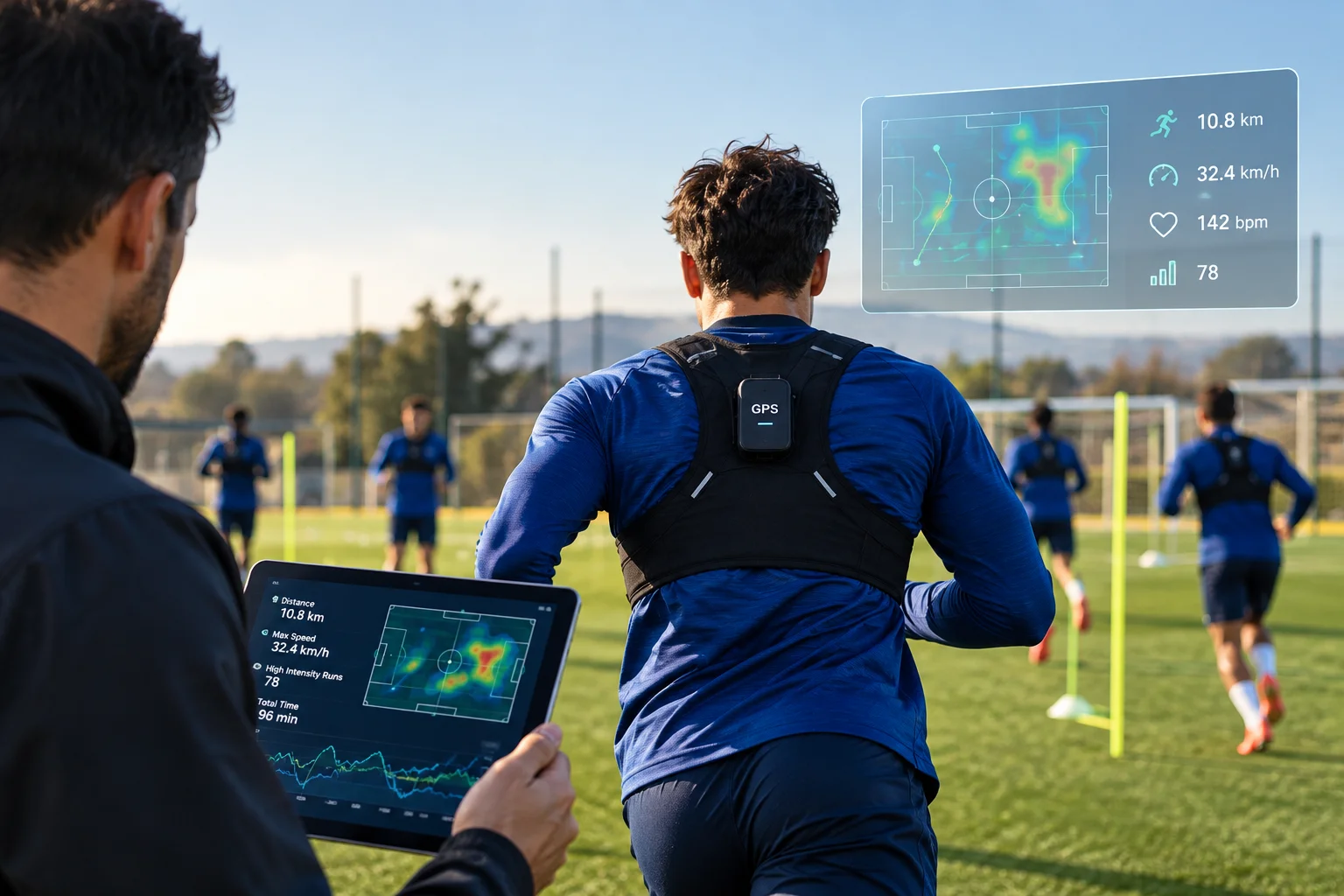
The small black unit sitting between a player’s shoulder blades has become one of the most familiar sights in modern football. It is a GPS tracker, worn in a vest under the shirt, and it records almost everything the player does physically during a match or training session.
What began as a curiosity has become central to how clubs manage their players. It has changed training, changed how injuries are prevented and changed how managers decide who is ready to play.
What does the tracker actually measure?
Movement, in enormous detail.
The unit combines satellite positioning with sensors that detect acceleration and changes of direction. From that it calculates total distance covered, distance at different speeds, the number and intensity of sprints, accelerations and decelerations, and the load placed on the body through impacts and changes of direction.
All of that is recorded many times per second and sent to the sports science staff, who can see each player’s output during and after every session.
Why did clubs adopt it?
Because it replaced guesswork with measurement.
Before tracking, a coach judged how hard a session had been by watching it. That was unreliable, since two players doing the same drill could work at very different intensities without it being visible. GPS gave staff an objective record of what each player had actually done, which allowed training to be planned and adjusted individually.
The technology also made it possible to compare training load against match load. Staff could see whether a session had been harder or easier than a match, and plan the week so that players arrived at the weekend neither undertrained nor exhausted.
How do staff use it week to week?
They plan backwards from the match. Early in the week, sessions carry the heaviest load. As the match approaches, load drops so players arrive fresh. Tracking lets staff see whether each day hit its target, and adjust the next day if it did not.
How does it help prevent injuries?
By showing when a player’s load is rising too fast.
Many soft-tissue injuries follow a sudden increase in workload, when a player does far more high-intensity running in one week than his body is used to. Tracking data makes those spikes visible before the injury happens. If a player’s sprint distance or high-speed running climbs sharply, staff can reduce his load in the following sessions rather than waiting for a hamstring to go.
It works the other way too. A player returning from injury can be brought back gradually, with his output increased in controlled steps until it matches match demands, rather than being thrown back in and hoping.
What does it tell a manager on matchday?
Whether a player is physically ready, and sometimes when he is running out of energy during a game.
Live tracking during matches lets staff see when a player’s output is dropping, which can inform substitutions. A midfielder whose high-speed running has fallen sharply in the seventieth minute may be a candidate to come off before he makes the tired mistake that costs a goal.
The data also feeds into selection. A player whose training numbers are consistently below his normal levels may be carrying fatigue or a minor problem, and managers now have that information rather than relying on the player to say so.
Has it changed how players train?
In several ways, some of which players like less than others.
Sessions are now designed around targets for distance, intensity and load, and players know their numbers are being recorded. Some find that motivating. Others find it intrusive, particularly when the data is used to question their effort. Managers have learned to use it carefully, as one piece of information alongside what they see with their own eyes.
It has also shaped how sessions are structured. Drills are designed to produce specific physical outputs, and the week is planned so that the total load builds towards the match and then drops off.
What do the numbers look like?
They vary by position, and that variation is part of what makes the data useful.
Central midfielders and full-backs typically cover the most ground and produce the most high-speed running, since their roles involve constant movement between defence and attack. Centre-backs cover less distance but record more short, sharp accelerations and jumps. Forwards produce fewer total runs but a high proportion of flat-out sprints. Goalkeepers barely register on distance at all.
Because of that, a player’s numbers are compared against his own history and against others in his position, not against the whole squad. A centre-back running as far as a midfielder would be a sign something was wrong, not a sign of effort.
What are its limits?
It measures what a player does, not how well he does it.
Tracking records that a midfielder sprinted forty times, not whether those sprints were in the right direction at the right moment. It cannot measure decision-making, technique or the quality of a pass. A player with modest physical numbers can be far more effective than one with impressive ones, and good staff know this.
There is also a risk of over-reliance. Some coaches have been criticised for managing players by the numbers rather than by watching them, and the best use of the data is alongside judgement rather than instead of it.
Do players get to see their own data?
Increasingly, and it has changed how they think about their own bodies.
Many clubs now share tracking data with players directly, either through apps or in one-to-one reviews with sports science staff. Players can see their own distance, sprint counts and load across a week and compare them with previous weeks. Some use it to push themselves harder. Others use it to argue for rest when they feel their load is climbing too high. Either way, the conversation between player and staff is better informed than it was.
Where is it going?
Towards more detail and more integration.
Trackers now measure more than they did, and the data is increasingly combined with other sources such as sleep, heart rate and wellness questionnaires to build a fuller picture of each player’s state. Our piece on sleep and recovery in professional football covers the part of that picture that tracking cannot see.
The technology has also spread well beyond the top level. Semi-professional and even amateur clubs now use cheaper versions, and the principles that made it valuable at the top apply just as well further down.
It has also changed the conversation about players in the media, which now discusses distance covered and sprint counts as routinely as goals and assists. Whether that is an improvement is debatable. The numbers are real, but they measure effort rather than quality, and the two are not the same thing.
Frequently asked questions
What is the vest footballers wear under their shirts?
A GPS tracking vest, which holds a unit that records distance, speed, sprints, accelerations and physical load during matches and training.
What does GPS tracking measure in football?
Total distance, distance at different speeds, number of sprints, accelerations and decelerations, and the overall physical load on the player.
How does GPS data prevent injuries?
By showing when a player’s workload rises too quickly, which is a common cause of muscle injuries, so staff can reduce load before a problem develops.