

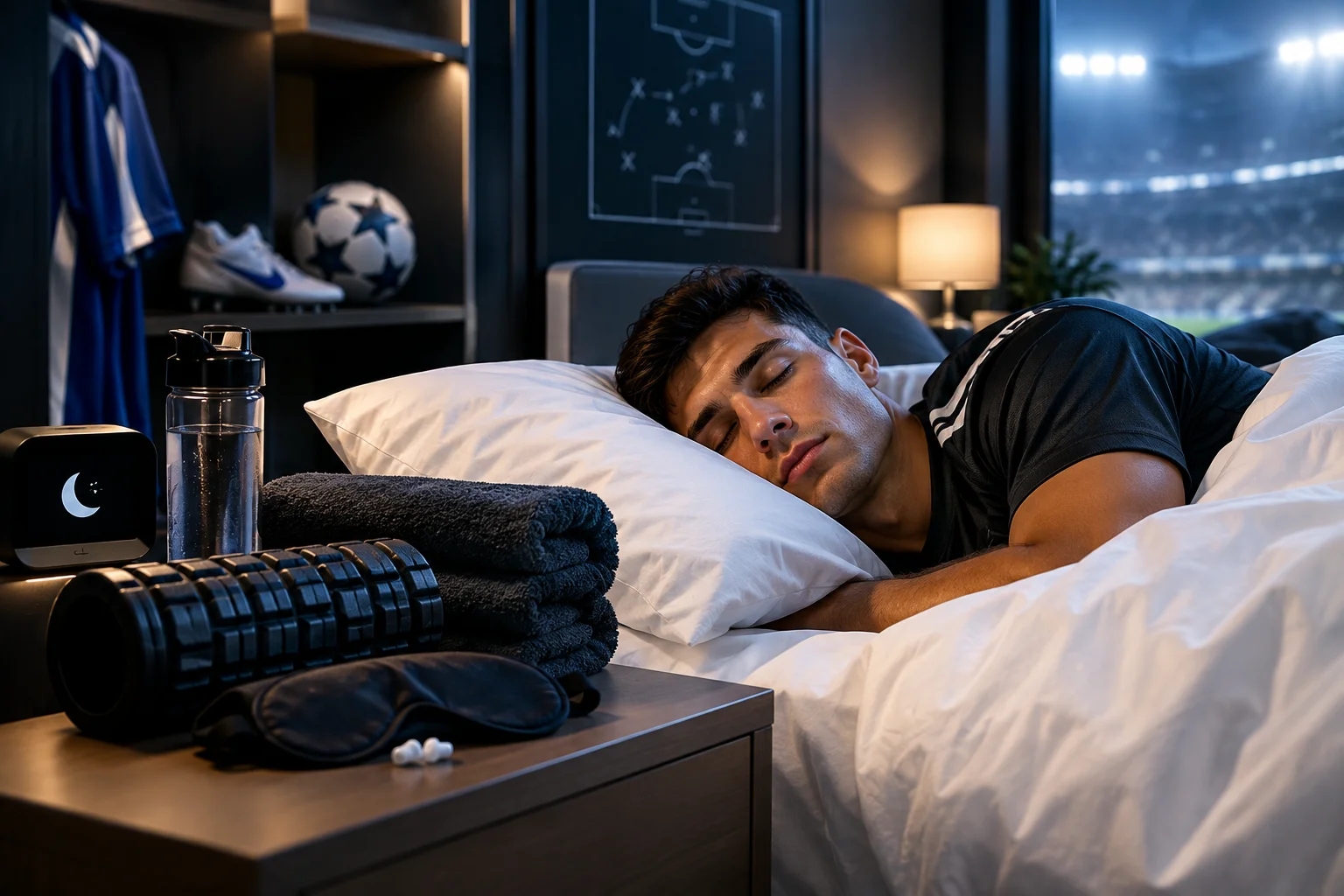
For most of football’s history, what a player did between the final whistle and the next training session was his own business. That has changed. Sleep is now treated as part of a professional footballer’s job, monitored, planned and discussed in the same way as diet and training load.
The reason is simple. Sleep is when the body repairs the damage a match does, and a player who does not get enough of it recovers more slowly, performs worse and gets injured more often.
What does sleep actually do for a player?
It is when most of the physical repair happens.
A match damages muscle fibres, drains energy stores and fatigues the nervous system. Much of the work of rebuilding that damage takes place during sleep, when the body releases the hormones that drive tissue repair and growth. A player who sleeps well after a match starts the recovery process properly. One who sleeps badly delays it.
Sleep also restores the mental sharpness that football demands. Reaction time, decision-making and concentration all decline with poor sleep, and those are exactly the qualities that decide tight matches.
What happens when players sleep badly?
Performance drops in ways that are measurable and injury risk rises.
Studies across sports have consistently found that reduced sleep slows reaction times, impairs judgement and reduces sprint performance. In football terms that means a fraction of a second later to the ball, a poorer decision in the final third, a tackle mistimed. Individually small, but they accumulate across a match.
The injury link is well established too. Fatigued players are more prone to muscle strains, and sleep deprivation is one of the most reliable ways to produce that fatigue.
Why do footballers struggle to sleep?
Because the job works against it.
Evening kick-offs mean players finish a match at ten o’clock at night with adrenaline still high, and many find it difficult to sleep for hours afterwards. Travel disrupts routines, particularly for European fixtures involving flights and time zone changes. And the mental pressure of the job, the replaying of mistakes and the anxiety about selection, keeps some players awake regardless of how tired their bodies are.
Late matches are the biggest culprit. A player who finishes at ten, does his post-match work, travels home and finally sleeps at two in the morning has lost a large part of the night that matters most.
How do clubs manage it?
Increasingly carefully, and with specialist help.
Many clubs now employ sleep coaches or work with sleep scientists who assess individual players and design routines for them. Players are given advice on wind-down routines after evening matches, on limiting screens and caffeine, and on room conditions such as temperature and light. Some clubs have installed sleep pods at training grounds for daytime naps between sessions.
Travel is planned with sleep in mind, with clubs choosing flight times and hotel arrangements to minimise disruption. And training schedules after late matches are adjusted, with later starts the following morning.
What about the night before a match?
It matters more than the night after, in some respects, because it determines the state a player starts the match in.
Clubs put considerable effort into the pre-match night, particularly for away games where players sleep in hotels. Rooms are checked for light and noise, players are encouraged to keep their usual routine rather than staying up, and meal timing is planned so that digestion does not interfere with sleep. A player who sleeps well before a match has sharper reactions and better judgement from the first minute, which is exactly when the difference shows.
Does napping help?
For most players, yes, and it has become a normal part of the routine.
A short nap in the early afternoon, particularly on matchday or the day after a late game, helps restore alertness and supports recovery without disrupting the night’s sleep. Longer naps can leave players groggy and make it harder to sleep later, so clubs generally advise keeping them brief.
The practice was once seen as laziness. It is now understood as sensible recovery.
Does caffeine help or hurt?
Both, depending on timing. Many players use caffeine before matches for alertness, and it works. The problem is that it stays in the system for hours, and a coffee taken before an evening kick-off is still active when the player is trying to sleep at one in the morning. Clubs increasingly advise limiting caffeine to earlier in the day on match days for exactly that reason.
How does sleep interact with fixture congestion?
It makes the problem worse.
During busy periods, players already have less time to recover between matches. If the matches are also late kick-offs, they lose sleep on top of losing recovery time, and the two effects compound. This is why the combination of midweek evening games and weekend fixtures is so hard on squads, and why managers rotate players during those periods even when they would prefer not to.
Our piece on how fixture congestion affects player fatigue covers the recovery timeline in detail, and sleep sits at the centre of it.
How do players sleep after an evening match?
With difficulty, and clubs have developed routines to help.
The standard advice is to lower the lights and avoid screens as soon as possible after the game, to eat a proper recovery meal rather than snacking late, and to avoid caffeine from the afternoon onwards on match days. Some players use breathing exercises or cool showers to bring their body temperature and heart rate down. The aim is to shorten the gap between the final whistle and sleep, since every hour lost after a match is an hour of recovery not happening.
Clubs also adjust the following day. Training after a late match usually starts later, and the session is light, so players who slept badly are not asked to do heavy work on top of it.
What can amateur players learn from this?
Most of it applies at any level.
Sleep after training and matches is when the body does its repair work, and skimping on it slows recovery and raises the chance of picking up a strain. A consistent routine, a cool dark room, less screen time before bed and a short nap after a hard session all help. None of it requires a sleep coach.
The professionals have simply made explicit what most people know instinctively: you cannot train hard and recover properly on five hours a night.
The wider point is that recovery is now understood as something that happens between sessions rather than only during them. Sleep is the largest part of that, and treating it seriously is one of the clearest differences between how footballers were managed a generation ago and how they are managed now.
Frequently asked questions
Why is sleep important for footballers?
It is when the body repairs muscle damage, restores energy and recovers mental sharpness. Poor sleep slows recovery, reduces performance and raises injury risk.
How much sleep do professional footballers get?
Clubs generally aim for players to get a full night’s sleep, with additional naps during busy periods. Late kick-offs and travel make this difficult, which is why it is now actively managed.
Do football clubs have sleep coaches?
Many do, either as staff or consultants, and they design individual routines for players and advise on travel, room conditions and post-match wind-down.