

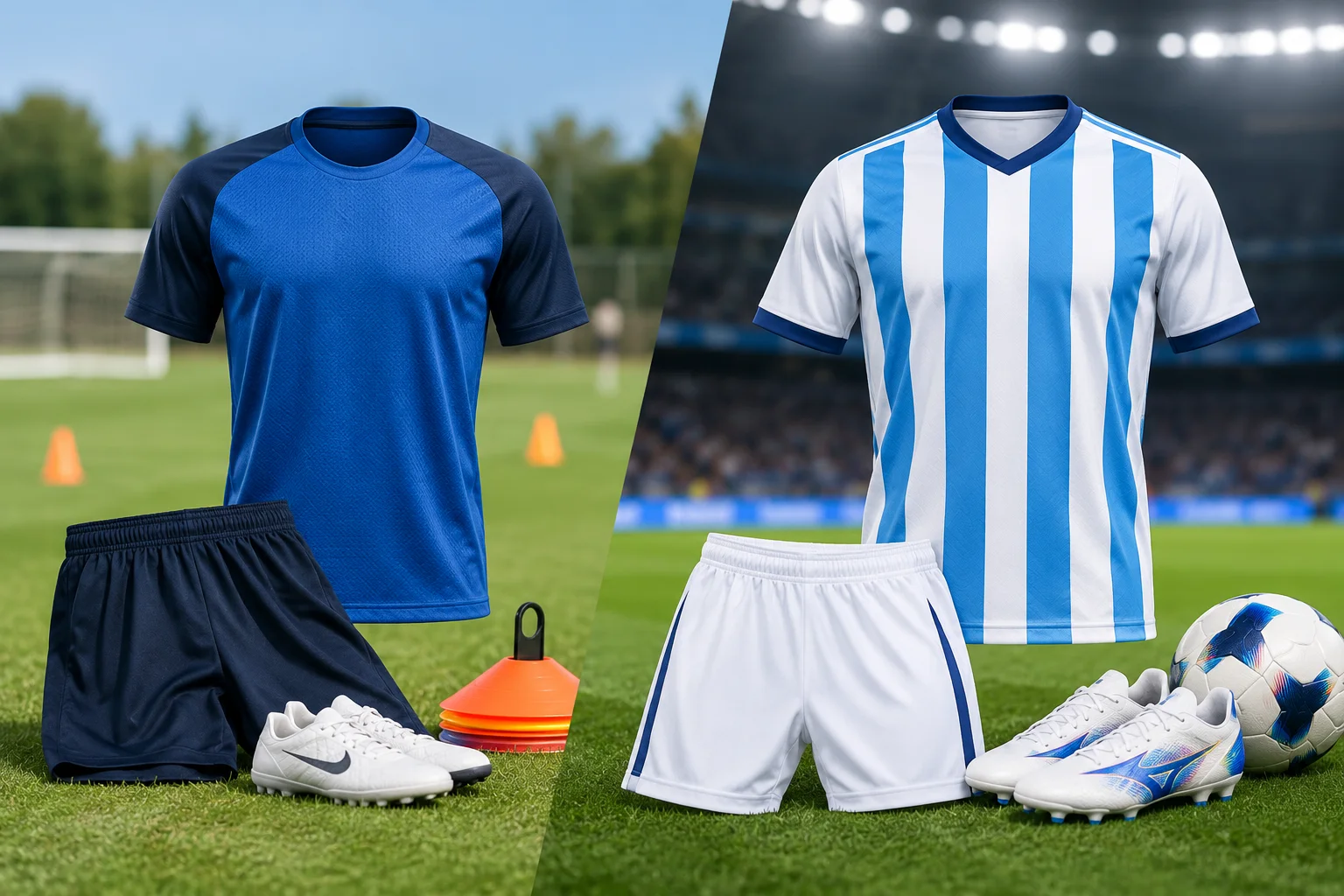
Most people assume training kit is a cheaper, plainer version of the match shirt. It is not. It is a different garment built for a different job, and the two are engineered in almost opposite directions.
A match shirt is designed to be as light as possible for ninety minutes and then washed. Training kit is designed to be worn several times a week, in all weathers, for a whole season, and to survive it. Understanding that difference explains most of what separates the two.
What is training kit designed to do?
To last, and to work across a much wider range of conditions than a match shirt ever faces.
A club’s players train far more often than they play, and they do it in rain, cold, heat and wind. Training kit therefore has to handle a cold morning session in January and a warm afternoon in August with the same garments, or at least with a range of garments that layer together. It also has to tolerate repeated washing at a rate no match shirt is expected to.
That means heavier fabrics, more robust construction and a design that prioritises durability and versatility over the last few grams of weight.
How does the fabric differ?
The polyester base is often similar, but the knit and weight are not.
Match shirts use the lightest viable knit with aggressive ventilation, because the only thing that matters is performance across one game. Training tops use a heavier, denser knit that resists abrasion, holds its shape through hundreds of washes and provides some warmth on its own. They still wick moisture, since players sweat just as much in training, but the balance tips towards durability.
Many training ranges also include fleece-lined or brushed-back tops for cold conditions, which have no equivalent in a match range.
Why does layering matter so much?
Because training kit is worn in every season and layering is how one range covers all of them.
A typical training range is built around a base layer, a lightweight training top, a mid-layer such as a quarter-zip or drill top, and an outer layer for rain or wind. On a mild day a player wears one or two of those. On a cold, wet morning all four. The pieces are designed to fit over one another without bunching, which is why the cut of each layer is calculated with the others in mind.
Buying football training kit for yourself works the same way. A single training top does one job. A top, a mid-layer and a jacket together cover most of the year.
How is the fit different?
Roomier, generally, and for practical reasons.
Match shirts, particularly player versions, are cut close to the body to reduce drag and stop the fabric flapping. Training tops are cut with more room, partly to allow layering underneath and partly because a session involves far more varied movement than a match: stretching, ground work, gym exercises, and long periods standing still listening to a coach.
Training shorts and trousers follow the same logic. Tracksuit bottoms and drill trousers exist in training ranges because players spend a lot of a session not running, and keeping the leg muscles warm between drills reduces injury risk.
What should you check when buying it?
The same construction checks as a match shirt, with the emphasis shifted towards wear.
Stitching at the hem, cuffs and shoulders matters more here, because training kit is stressed far more often. Look for dense, even seams. Check the zip quality on any mid-layer or jacket, since zips are the first thing to fail on garments that are pulled on and off several times a day.
Fabric weight is the other check. A training top that feels as light as a match shirt is not really training kit, and it will not survive a season of use. A reasonable weight in the hand is a feature rather than a drawback.
What about goalkeeper training kit?
A separate category, and built even more heavily.
Goalkeepers spend training sessions diving repeatedly onto grass and artificial surfaces, so their training tops and trousers include padding at the elbows, hips and knees, and use fabric that resists abrasion far better than an outfield top. The padded trousers in particular have no outfield equivalent and are among the most durable garments in any club’s range.
How should training kit be washed?
Cool, inside out, no softener and no tumble dryer, exactly as with a match shirt. The difference is frequency, since training kit goes through the wash far more often, which makes the softener rule more important. A coating that builds up across a season of daily washing will destroy the wicking properties long before the fabric itself wears out.
Fleece-lined and brushed items should be washed cool as well, since heat flattens the brushed surface that provides the warmth.
Does training kit change between seasons?
Less than match kit, and that is useful for buyers.
Match shirts are redesigned every year because the design is the product. Training ranges change more gradually, with colours and small details updated but the core pieces carrying over. That means last season’s training top is often indistinguishable from this season’s in everything but the shade, and it will usually be reduced.
For anyone building a set of layers, that makes the previous season’s range the obvious place to start. The garments are the same, the price is lower, and nobody will know the difference.
Why do clubs sell so much of it?
Because supporters wear it more than match shirts.
A match shirt is a statement worn to games and on match days. Training kit is worn to the gym, on the walk to school, on a Sunday morning. It is the club clothing people actually live in, which is why training ranges have grown so large and why the manufacturer’s logo appears on every piece.
For the science behind why the match shirt is built the way it is, our breakdown of how football kit fabric actually works covers the other side of the comparison.
For a supporter, the practical upshot is simple. Buy the training range when you want something to wear regularly, and buy it a season behind for the best price. Buy the match shirt when you want the shirt itself. They are different purchases, and treating them as the same thing is how people end up with a match shirt that falls apart from daily wear or a training top they never wanted.
Frequently asked questions
What is the difference between training kit and match kit?
Match kit is built to be as light as possible for a single game. Training kit is heavier, more durable and designed to layer, because it is worn several times a week in all conditions for a whole season.
Is training kit warmer than a match shirt?
Usually. Training tops use denser fabric and many ranges include fleece-lined or brushed-back options, which match ranges do not.
Why is training kit cut looser?
To allow layering underneath and to accommodate the varied movement of a training session, which includes stretching, gym work and standing still as well as running.