

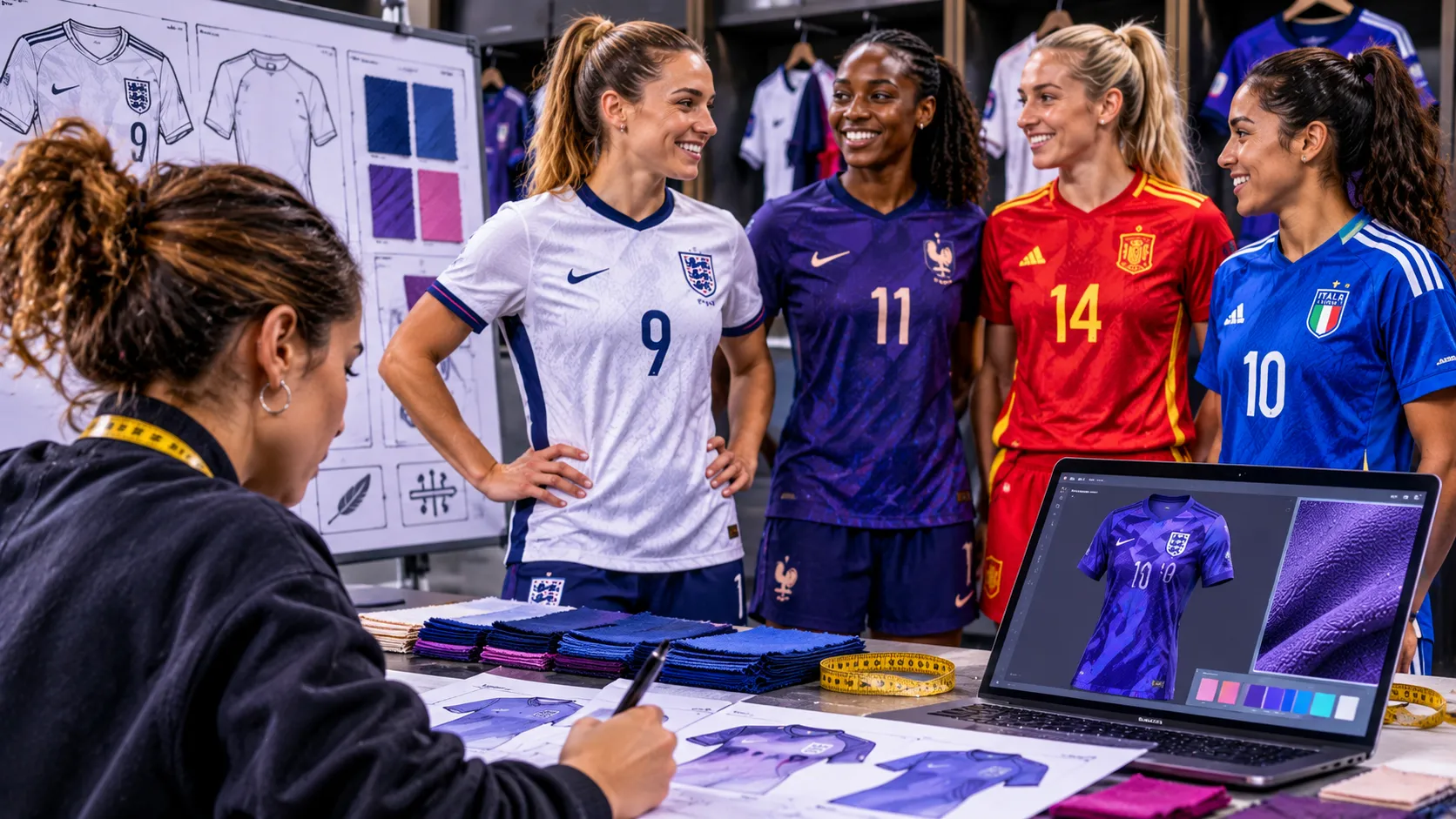
For most of the women’s game’s modern history, women’s football kit was not designed for it. Shirts were cut on men’s patterns in smaller sizes, shorts were whatever the men’s team wore, and boots were built on a last shaped from a male foot. None of that was a considered decision it was simply what existed, scaled down.
That has changed substantially in the last decade, and the changes are a useful case study in what kit engineering actually does, because each one was a response to a specific problem players kept raising. This is what has moved, what has not, and where the evidence is still thin.
Starting from the wrong pattern
A shirt cut on a men’s block and made smaller does not fit a different body shape; it fits nothing particularly well. The shoulder seam sits too far out, the body runs straight where it needs to shape, the sleeve is long and the neckline is set for a different chest.
The fix is a separate pattern rather than a smaller size, and that is what a properly designed women’s shirt now is: narrower at the shoulder, shaped through the waist, shorter in the sleeve and the body, with a different neck opening. This matters for performance as well as comfort. A fabric can only wick moisture where it is in contact with skin, so a shirt that stands away from the torso leaves the sweatiest part of the back doing nothing the point we make in how fit and weight change the way a shirt performs.
Shorts were the bigger gap for longer. A men’s short pattern is cut for a different hip-to-waist relationship, and the result sat badly and restricted stride. Dedicated patterns arrived late and made an immediate difference.
Why did teams stop wearing white shorts?
The clearest example of kit designed without consulting the people wearing it. For years many women’s teams played in white shorts because the men’s team did, and players had been raising the obvious problem privately for a long time before it was discussed publicly: white shorts are a source of genuine anxiety for anyone menstruating, and that anxiety affects how someone plays.
Once it was raised openly, several clubs and national sides changed. England’s switch away from white shorts after players pushed for it was the most visible, and others followed quickly. It is worth noting precisely because it cost nothing and improved things measurably it was not a technical problem, it was a listening one.
The wider lesson is the one kit designers now repeat: the useful information comes from players, not from laboratories, and for a long time nobody was asking.
Support, and why it is part of the kit
Breast support is performance equipment rather than underwear, and treating it as the latter held the game back. Poorly fitted support affects running mechanics, restricts breathing when it is too tight, and causes pain that changes how a player moves all of which are performance variables.
The research base here is small but clear enough to act on: correctly fitted, high-support garments reduce movement and discomfort during running, and a large proportion of athletes across sports are wearing the wrong size. Clubs now fit players individually rather than issuing stock sizes, which is a recent change and an obvious one in hindsight.
Several manufacturers now design the support garment and the shirt as a system rather than separately, accounting for how straps and seams interact. That is the kind of detail that only appears once somebody treats the category seriously.
Why are boots the slowest thing to change?
Because a boot is built around a last a solid form in the shape of a foot and developing a new one is expensive. For decades women’s boots were men’s boots in smaller sizes, which ignores documented differences in foot shape: generally a narrower heel relative to the forefoot, a different arch profile and a different instep height.
A boot that fits badly does more than hurt. It changes how force travels through the foot and ankle, encourages compensations further up the chain, and is a plausible contributor to injury patterns. Women-specific lasts now exist from the major manufacturers, but the range is still narrower than the men’s and the cost is higher, which pushes a lot of players at non-elite level back into whatever fits.
The injury question, handled honestly
Serious knee injuries, and ACL ruptures in particular, occur at a higher rate in women’s football than in men’s. That much is well established across many studies. What causes it is contested, and anyone offering a single confident explanation is overselling the evidence.
The candidates include anatomical and biomechanical differences in how the knee is loaded during landing and changing direction, hormonal influences on connective tissue, and critically a long list of things that have nothing to do with bodies at all: poorer pitch quality, less access to strength and conditioning through adolescence, boots designed on the wrong last, denser fixture calendars relative to squad size, and a research literature that has studied male athletes far more thoroughly.
The honest summary is that the gap is real, the causes are mixed, and the under-resourcing is the part most obviously fixable. Our piece on why hamstring injuries dominate football covers how load management works when it is done properly.
What this means if you are buying
Three practical points. A women’s-fit replica is a different pattern rather than a smaller size, so it will fit differently from a small unisex shirt and not everybody prefers it try both if you can. Women’s-fit ranges are often produced in a shorter size run, so the extremes may not exist. And a women’s team shirt, a women’s-fit men’s team shirt and a small unisex shirt are three different products that listings frequently conflate.
The broader market for womens football shirts is considerably better stocked than it was five years ago, and the engineering behind the better ones is genuine rather than cosmetic. For what the fabrics themselves are doing, see football kit technology explained.
What has actually been measured
It is worth being precise about where the evidence is solid, because the area attracts a lot of confident assertion. Fit and pattern differences are well established and uncontroversial those are measurable anthropometric facts and the garment industry has acted on them.
Support is reasonably well studied, with consistent findings on movement reduction and on how many athletes are wearing the wrong size. Boot fit is documented in terms of foot shape differences; the injury consequences of poor fit are plausible and less thoroughly quantified.
Beyond that it thins quickly. Thermoregulation, hydration needs and recovery timelines in female athletes have far smaller literatures than the equivalent work on men, and most published guidance was derived from male samples and applied across the board. That is the honest state of it, and it is improving rather than solved.
Where the research still is not
Most sports-science literature was built on male participants, and the gap has consequences beyond kit. Hydration guidance, heat acclimatisation protocols, load monitoring thresholds, recovery timelines and return-to-play criteria were largely derived from studies of men and applied across the board.
That is changing, but slowly, and it is the single biggest reason confident claims in this area should be treated carefully. The next piece in this series looks at an area where the evidence did eventually force a change in the rules: how concussion protocols changed football.
Frequently asked questions
Is a women’s-fit shirt just a smaller version?
No. It is a different pattern narrower shoulder, shaped waist, shorter sleeve and body, different neckline. A small unisex shirt is straight-cut and simply smaller.
Why did teams stop wearing white shorts?
Because players raised the anxiety white shorts cause while menstruating, and clubs accepted the point. It cost nothing to change and had a measurable effect on how comfortable players felt.
Are women’s football boots genuinely different?
The better ones are built on a women-specific last, accounting for documented differences in foot shape. Many boots sold for women are still men’s lasts in smaller sizes.
Why are ACL injuries more common in women’s football?
The higher rate is well established; the causes are contested and almost certainly multiple, including biomechanics, pitch and boot quality, access to conditioning, fixture load and a research base weighted towards male athletes.