

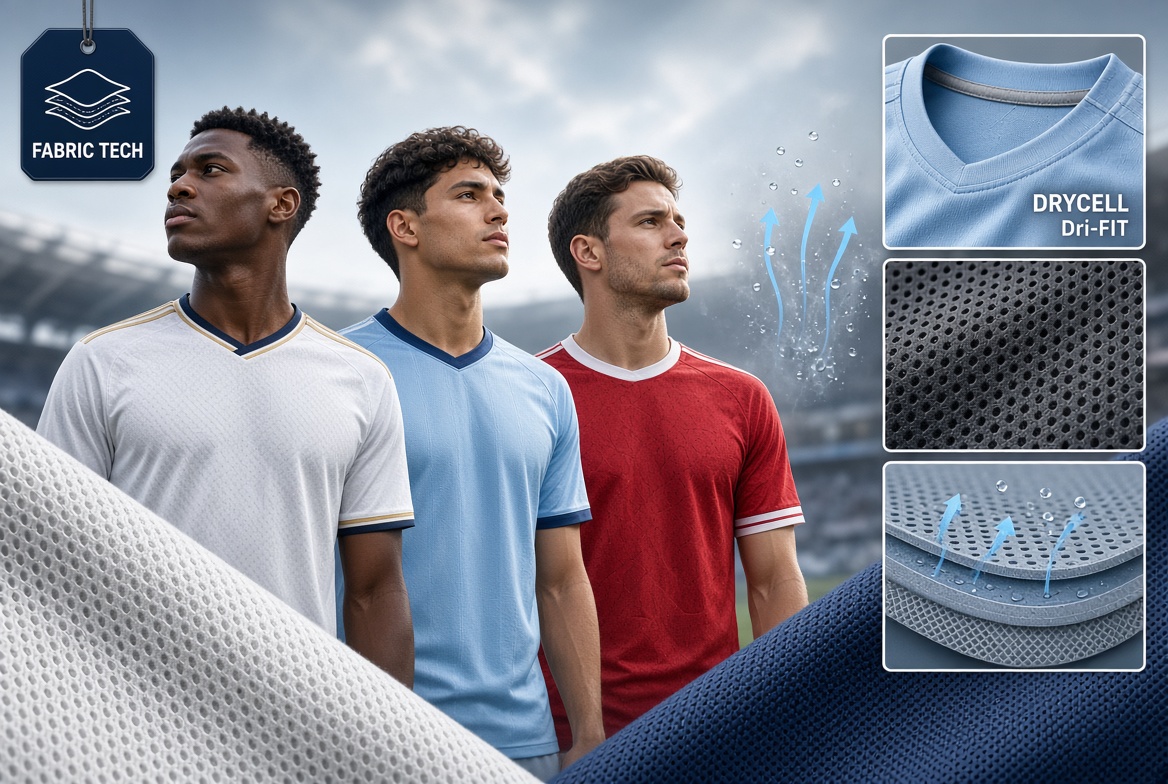
Two shirts can be made of the same material and perform completely differently. The fibre is only the starting point. What determines whether a kit is comfortable through ninety minutes is how that fibre has been knitted, where the density varies, and how much air the structure moves.
This is also the part of a kit that is hardest to assess from a listing, which is why it is worth understanding properly.
Why polyester replaced cotton
Cotton absorbs moisture into the fibre itself and holds it. That is comfortable in a shirt you are sitting still in and a serious problem in one you are running in, because the shirt gets progressively heavier, colder against the skin and slower to dry.
Polyester is hydrophobic at fibre level. It absorbs almost nothing, so moisture moves along the surface and through the spaces between fibres rather than soaking in. That movement is what allows sweat to spread across a wider area and evaporate, rather than pooling where it was produced.
The change was not about cost, though cost helped. It was about the fibre doing something cotton structurally cannot.
What does wicking actually mean?
It describes moisture travelling through a fabric by capillary action, moving from areas of high concentration towards areas where it can evaporate.
For it to work, the fabric needs the right spacing between fibres. Too tight and there is no capillary path. Too open and the fabric loses contact with the skin, which is where the moisture starts. Good performance fabric is engineered into a narrow window between those extremes, and hitting that window consistently is what separates a well made kit from a poor one.
This is also why fabric softener is so damaging. It deposits a coating across the fibre surfaces that blocks the capillary spaces. A shirt washed repeatedly with softener loses the property it was built around, and there is no practical way to restore it.
Why is the knit structure so important?
Because the same polyester yarn can be knitted into fabrics that behave nothing alike.
A tight, flat knit moves very little air and wicks poorly. An open, textured knit with deliberate variation in density moves considerably more air and spreads moisture across a larger surface. That is why good shirts have visible texture in close up, and why a uniform smooth surface across an entire garment usually indicates the cheapest available base cloth.
Anyone comparing cheap football kits can use this directly. Look for texture, look for variation across the garment, and treat a completely flat surface as a warning rather than a neutral observation.
Where should the ventilation be?
Not evenly distributed, which is the point.
Heat and sweat production vary enormously across the body. The upper back and the region between the shoulder blades run hottest. The underarms produce the most moisture. The chest and lower front run cooler and also need a stable surface for the crest and sponsor to sit on.
So a properly built kit uses a more open structure across the back and under the arms, and a denser one at the front. Visible mesh panels on the back of a shirt are not decoration. They are placed where the physiology requires them, and their absence on a shirt claiming performance specification is telling.
Does fabric weight matter?
Yes, but not in the direction people assume. Lighter is generally better up to a point, and past that point it becomes a problem.
A lighter fabric moves more air and dries faster. But it is also less durable, less opaque, and more prone to snagging and pilling. Match shirts are made light because they need to be for ninety minutes and are replaced frequently. A fan shirt that will be worn weekly for three years needs more robustness than that.
This is the core trade between player version and replica construction, and it is why the replica is the right purchase for most people despite being the heavier garment.
How do you judge fabric from a listing?
You work with what is shown, and some sellers show a great deal more than others.
Look for close up photography where the knit texture is visible. Look for variation in that texture across different parts of the shirt. Look for any stated fabric weight or knit description, which is a signal the seller knows what they are selling. And look at the hem and cuffs, where stitching density predicts how the garment will hold up.
A listing made entirely of flat renders on white backgrounds is asking you to take the fabric on trust. That is not automatically a bad sign, but it removes your ability to check. For the wider commercial context that shapes what ends up in production, ESPN’s football coverage follows the kit and sponsorship side of the business.
Do recycled fabrics perform differently?
Most current football kit is made from recycled polyester, and the honest answer is that the performance difference is small.
Recycled polyester is chemically very close to virgin polyester, and the properties that matter here — low moisture absorption, the ability to be knitted into engineered structures — carry across. Where recycled material has historically lagged is in consistency, since feedstock quality varies more than virgin production does.
In practice that shows up as batch variation rather than a performance gap. A well made recycled kit performs essentially like a well made virgin one, and the things worth checking are unchanged: knit texture, panel structure, stitching density and crest attachment.
How should performance fabric be washed?
Cool, at thirty degrees, inside out. No fabric softener, for the reasons above. No tumble drying, because heat lifts heat pressed crests, cracks printed numbers and can damage bonded seams.
Polyester air dries quickly, since the properties that shed sweat also shed water. The drying time penalty for skipping the dryer is far smaller than people expect and the durability gain is considerable.
The short version
The fibre matters less than the knit. The knit matters less than where the density varies. And all of it matters less than not putting the shirt through a hot dryer with a cap of softener, which undoes the engineering faster than anything else you can do to it.
Children’s kits add another variable again, and our guide to kids football shirts, sizing and durability covers what changes. For the pricing side of all this, our piece on why football kits cost so much explains where the money goes.
Frequently asked questions
Does fabric softener really damage football shirts?
Yes. It coats the fibres and blocks the capillary spaces that moisture travels through, which removes the wicking performance the fabric was engineered for. The effect is not reversible.
Are lighter football shirts better?
Up to a point. Lighter fabric ventilates and dries faster but is less durable and less opaque. For a shirt worn regularly over years, slightly heavier replica construction lasts considerably better.
Why do some shirts have mesh panels on the back?
Because the upper back produces the most heat. Mesh panels are placed where the body needs to shed heat fastest, which is why their placement is consistent across well designed kits.