

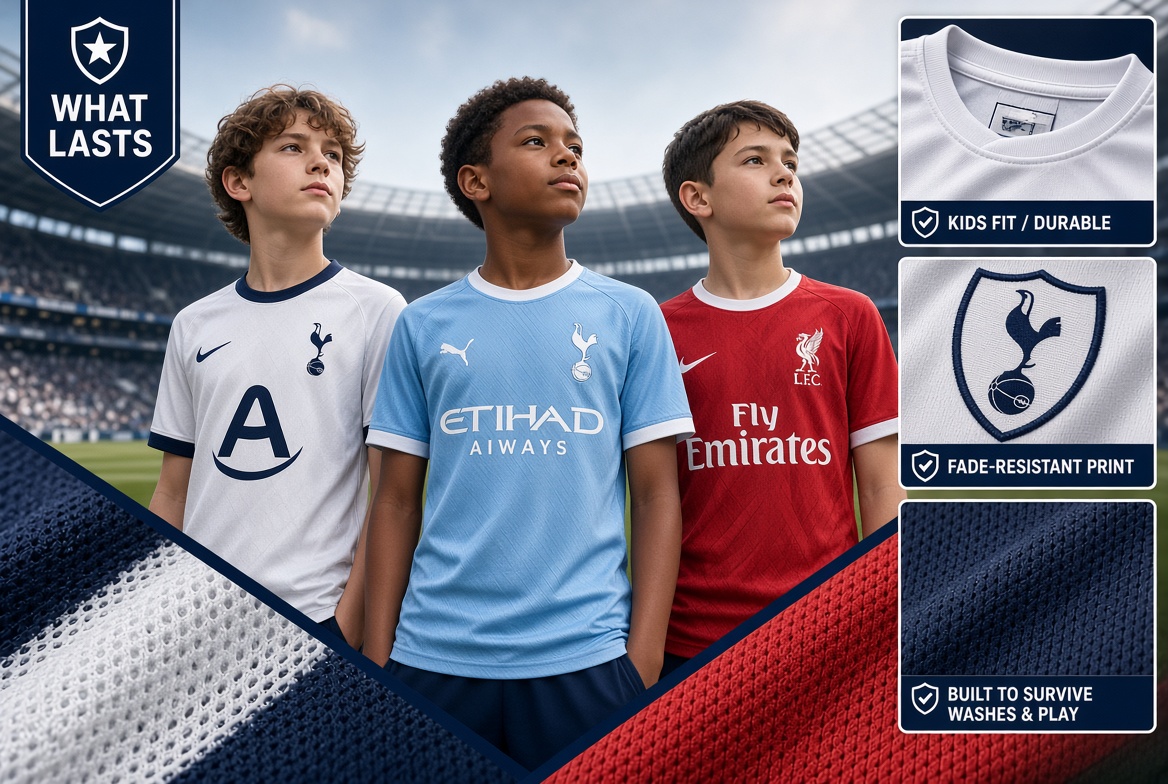
A children’s football shirt has a harder life than an adult’s by a wide margin. It gets played in rather than watched in, it meets walls and playground tarmac, and it goes through the wash several times a week rather than every other weekend.
That changes which qualities matter. Things that are nice to have on an adult shirt become the difference between a shirt that survives the year and one that does not.
Why age labels are only a starting point
Nearly every children’s football shirt is sold by age range. Ages 5 to 6, ages 7 to 8, and so on. It is convenient and it is not accurate, because children of the same age vary enormously in height and build.
What the age label actually encodes is a height range. A shirt marked for ages 7 to 8 is typically cut for a child somewhere around 125 to 135 centimetres. If your child is tall or small for their age, the label will mislead you and you will not discover it until the parcel arrives.
Use the age range to narrow the field and then read the height figures underneath. Any seller worth ordering from publishes them, and they are far more useful than the number on the front of the listing.
How much growing room should you allow?
Most people overcorrect here, and it backfires.
The instinct is to size up generously so the shirt lasts longer. But football shirts are already cut with room, and a child in something two sizes too big feels uncomfortable in it and will not wear it. A shirt that does not get worn has not lasted longer. It has simply failed differently.
One size up is the sensible ceiling, and only if your child is near the top of their current height range or visibly heading into a growth spurt. If they have just entered a range, buy that size. Fitting properly for a year beats fitting badly for two.
What construction survives actual wear?
This is where children’s shirts differ most from adult ones, because the failure points are not the same.
Crest attachment is the single biggest factor. A heat pressed badge on a child’s shirt has a hard life and lifts at the corners quickly, and once a corner lifts it keeps going. Embroidered or properly bonded crests survive. When people shop for kids football shirts they mostly look at the design and the price, but crest construction is what determines whether the shirt still looks decent by spring.
Stitching at the hem and cuffs comes next, since those take more stress on a child’s shirt than an adult’s. Even, dense stitching is what you want, and it is visible in a decent close up photograph.
Does the fabric need to be different for children?
The principles are the same but the priorities shift.
Adult performance shirts optimise heavily for lightness and ventilation, sometimes at the cost of durability, because a match shirt is replaced frequently. A child’s shirt worn multiple times a week needs the opposite balance. Slightly heavier, more robust fabric will outlast a very light one by a wide margin under that kind of use.
Ventilation still matters, particularly if the shirt is genuinely being played in, and the same principles apply: look for texture variation and more open structure across the back rather than a uniform flat surface.
Shirt only, or the full kit?
A shirt on its own is the common purchase and usually the right one. Children wear football shirts casually far more than they wear full kits, and the shirt is the part they actually care about.
A full kit makes sense if it is genuinely being worn to play in, or if it is a present where completeness is part of the appeal. Be aware that shorts are sized on the waist rather than the chest, so a kit sold in a single size assumes both measurements fall in the same place on the chart, which is often not true.
Socks will be the first thing to wear through in any kit that gets used. Assume they need replacing before anything else.
What about hand me downs and second hand shirts?
Children grow out of shirts long before the shirts wear out, which makes the second hand market unusually good here.
The things to check are the same as on a new shirt, plus two. Look at whether the crest corners have started lifting, since that is the most common failure and it is progressive rather than stable. And look at the fabric surface for pilling, which develops with heavy wear and does not affect fit but does affect appearance.
Printing is the other consideration. A shirt printed with a previous owner’s name is a harder sell to a child than a plain one, which is worth factoring in if you are buying with a specific reaction in mind.
How should you wash a child’s shirt?
Cool, at thirty degrees, inside out. This protects the crest and any printing more effectively than anything else available to you.
Avoid the tumble dryer entirely, because heat is what lifts heat pressed badges and cracks printed numbers. With a shirt being washed three times a week, the cumulative damage from repeated drying cycles adds up far faster than on an adult shirt.
Skip fabric softener, which coats the fibres and reduces the breathability the fabric was built for.
Should you print a name on it?
Printing is what makes a shirt feel like it belongs to a child rather than to a shop, and it is worth doing. It is also permanent and makes the shirt non returnable.
Printing their own name is the safer choice. A player’s name ties the shirt to a squad that will change, and children can be genuinely disappointed when the name on their back moves club. Their own name does not have that problem and tends to be the one they are prouder of anyway.
What to prioritise
Height range over age label. One size up at most. Crest construction over design. Slightly heavier fabric over the very lightest. Cool wash, no dryer, no softener. Their own name on the back.
That combination gets you a shirt that survives a year of being actually used, which is a higher bar than most adult shirts ever have to clear.
For the materials science behind those fabric choices, our breakdown of how football kit fabric works goes into the detail. And for how one club’s kit identity has evolved across two grounds, Brighton’s kits from the Goldstone to the Amex traces it.
Frequently asked questions
What size football shirt should I buy for a 7 year old?
Check the height range rather than the age. Shirts labelled for ages 7 to 8 are usually cut for children around 125 to 135 centimetres. Measure your child and match that figure.
Should I buy a bigger size so it lasts longer?
One size up at most, and only if they are near the top of their current height range. Beyond that the shirt is uncomfortable and does not get worn, which defeats the purpose.
Are kids football shirts made from the same fabric as adult ones?
Broadly similar materials, though children’s shirts benefit from slightly heavier and more durable construction because they are played in and washed far more often than adult shirts.