

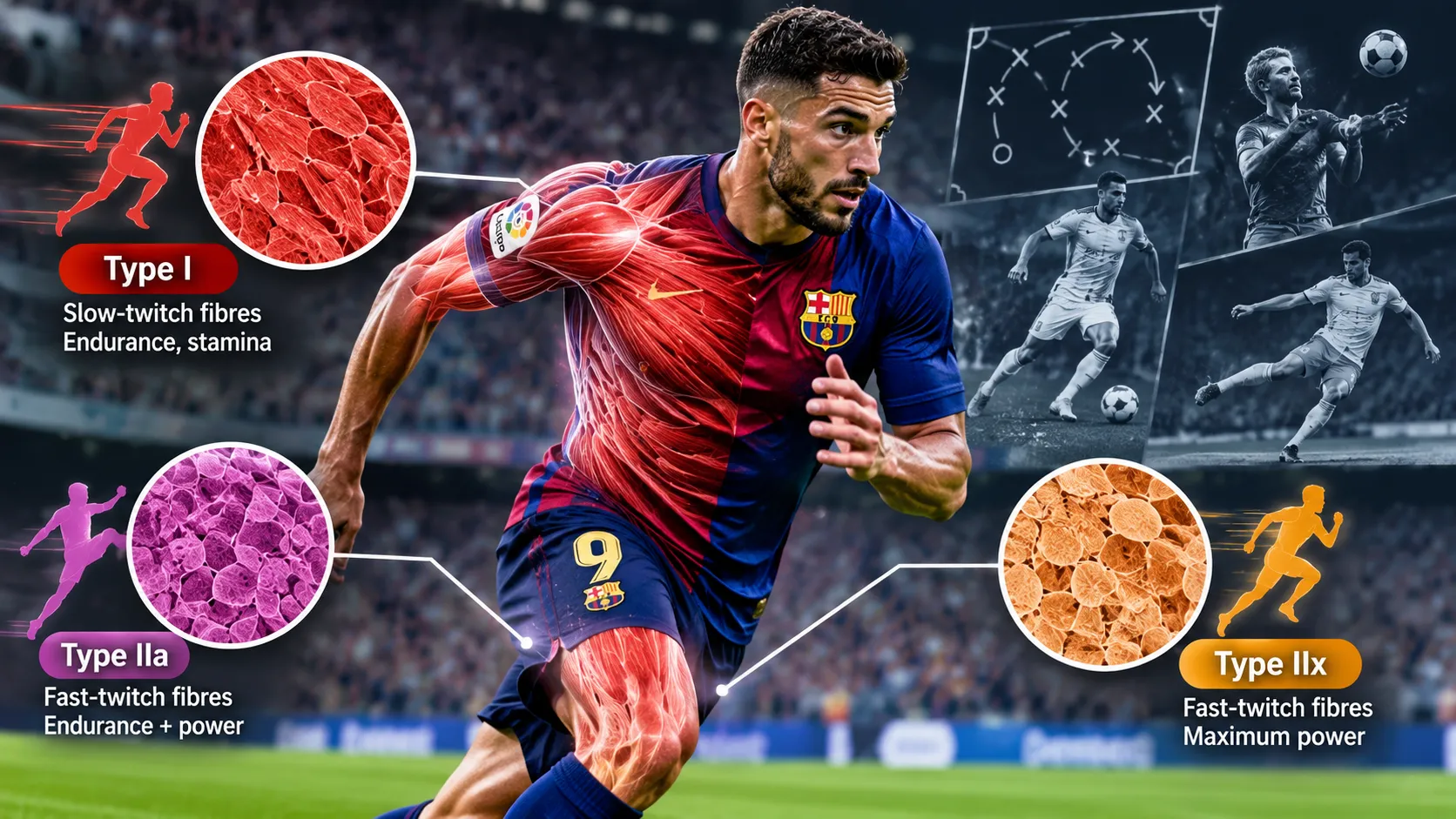
Working out how muscle fibre types shape a footballer explains something supporters notice constantly and rarely have language for: why some players are explosive and tire quickly, and others cover enormous distances without ever looking fast.
It is not attitude or fitness. It is largely the composition of the muscle itself, which is partly inherited and only partly trainable.
The two basic types
Slow-twitch fibres, usually called type I, contract relatively slowly, resist fatigue well and rely on oxygen to produce energy. They are the fibres that let a player run eleven kilometres in a match without stopping.
Fast-twitch fibres, type II, contract rapidly and powerfully, produce energy without oxygen, and fatigue quickly. They are what produces a five-metre burst, a jump, or a shot struck hard.
Type II subdivides further, and the distinction matters. Type IIa fibres are fast but relatively fatigue-resistant; type IIx are the fastest and tire almost immediately. Everyone has all three in varying proportions, and the proportion differs between individuals by a wide margin.
How this shows up on a pitch
A player with a high proportion of fast-twitch fibre is the one who beats a defender over five yards, scores from a half-chance, and looks exhausted by the seventieth minute. He is not unfit. His muscle is built for output rather than duration.
A player with a high slow-twitch proportion is the one who is still making runs in the ninety-third minute and has never beaten anyone for pace in his life. Central midfielders and full-backs in high-volume systems tend towards this profile.
Neither is better. They are different tools, and a side needs both which is why the best midfield pairings usually combine a high-volume runner with an explosive one rather than two of the same.
Can training change fibre composition?
Partially, and less than the fitness industry implies. The broad split between type I and type II is largely determined by genetics and is difficult to shift substantially in an adult.
What does change is the distribution within type II. Endurance training shifts type IIx fibres towards type IIa, making them more fatigue-resistant and slightly less explosive. Heavy strength and sprint work pushes in the other direction.
This is why training emphasis has real consequences for a player’s profile. A naturally explosive forward put through a season of high-volume endurance work will come out of it more durable and measurably less sharp, and the trade is not always worth making. That tension sits underneath most arguments about how much running a forward should do.
Does position predict fibre profile?
Broadly, and with enough exceptions to make it unsafe as a rule. Wide forwards and centre-forwards skew fast-twitch; central midfielders and full-backs in high-volume systems skew slow-twitch; centre-backs sit in between and vary enormously with the system they play in.
Goalkeepers are the interesting case. The job requires almost pure explosive output with very long recovery periods between efforts, which is about as fast-twitch a demand profile as exists in the sport, and almost nobody thinks of goalkeepers that way.
Causation runs both ways, which is why the correlation is imperfect. Players partly end up in positions that suit their physiology, and partly develop towards the demands of the position they were put in at fourteen. Separating the two is close to impossible with the data clubs actually have.
Why this matters for injury
Fast-twitch fibre is more vulnerable. Hamstring injuries concentrate in explosive players because the injury mechanism high-speed eccentric loading during the swing phase of a sprint is precisely what fast-twitch muscle is built to do and is strained by.
That is a large part of why the same players keep getting injured. It is not carelessness or bad luck; it is a muscle composition that produces both the acceleration and the risk, as set out in why hamstring injuries dominate football.
The management approach that works is load control rather than avoidance. Explosive players need the sprint exposure to stay robust, and they need it carefully dosed, which is why modern clubs monitor high-speed running volumes rather than total distance.
What clubs actually test
Not fibre composition directly, because the only accurate method is a muscle biopsy and no club is taking tissue samples from its squad for scouting purposes.
Instead they test proxies. Countermovement jump height and reactive strength index indicate explosive capacity; repeated sprint tests and aerobic assessments indicate fatigue resistance. The combination gives a usable profile without a needle.
Match data adds the rest. A player’s distribution of high-speed running across ninety minutes tells you more about his fibre profile than any single test, because it shows how output degrades under real fatigue rather than in a laboratory.
What this changes about recruitment
Clubs now profile physically before they commit, and a mismatch between a player’s build and the system he is being bought into is one of the more common reasons an expensive signing looks ordinary.
A side that presses high for ninety minutes needs fatigue-resistant forwards and will get poor value from an explosive one, however good he looked at a club that defended deep and countered. The player has not got worse; he has been asked for something his muscle does not produce.
This also explains why some transfers look better after a manager leaves. A player bought for one profile and used by a successor with different ideas is being measured against a demand he was never suited to, and the correction is usually a change of system rather than a change of player.
The recruitment lesson is dull and reliable: buy the profile the system needs, not the highlights. Profiles are measurable in ways highlights are not, which is why the clubs that do this well are the ones that keep finding value where others do not.
What this means for how you watch a player
Stop reading tiredness as a character flaw. A forward who is walking by the eightieth minute after three sprints at full tilt has done exactly what his physiology permits, and the alternative was not sprinting at all.
Look instead at whether a player is used in a way that matches his build. An explosive forward in a system that asks him to press continuously for ninety minutes is being wasted, and so is a high-volume midfielder asked to provide a burst he does not have.
The best managers build roles around composition rather than asking every player to do everything, and the good ones tell a player plainly what his job is and what it is not, which removes a whole category of pointless criticism from the dressing room. Ageing interacts with this too, because fast-twitch fibre declines earlier and faster which is why explosive players tend to peak younger, and why the preparation story behind Brazil retro shirts was about matching training to individuals rather than running everybody the same way.
Frequently asked questions
What is the difference between fast and slow twitch muscle?
Slow-twitch fibres contract slowly, use oxygen and resist fatigue. Fast-twitch fibres contract rapidly and powerfully without oxygen and tire quickly. Everyone has both in varying proportions.
Can you train yourself to have more fast-twitch muscle?
Not substantially. The broad split is largely genetic. What training does change is the balance within fast-twitch fibre, shifting it towards more or less fatigue-resistant forms.
Why do explosive players get injured more?
Because the injury mechanism for hamstrings high-speed eccentric loading during sprinting is exactly what fast-twitch muscle is built to produce. The capacity and the risk come together.
How do clubs assess this without a biopsy?
Through proxies: jump tests and reactive strength for explosiveness, repeated sprint and aerobic tests for fatigue resistance, plus how a player’s high-speed running degrades across a match.