

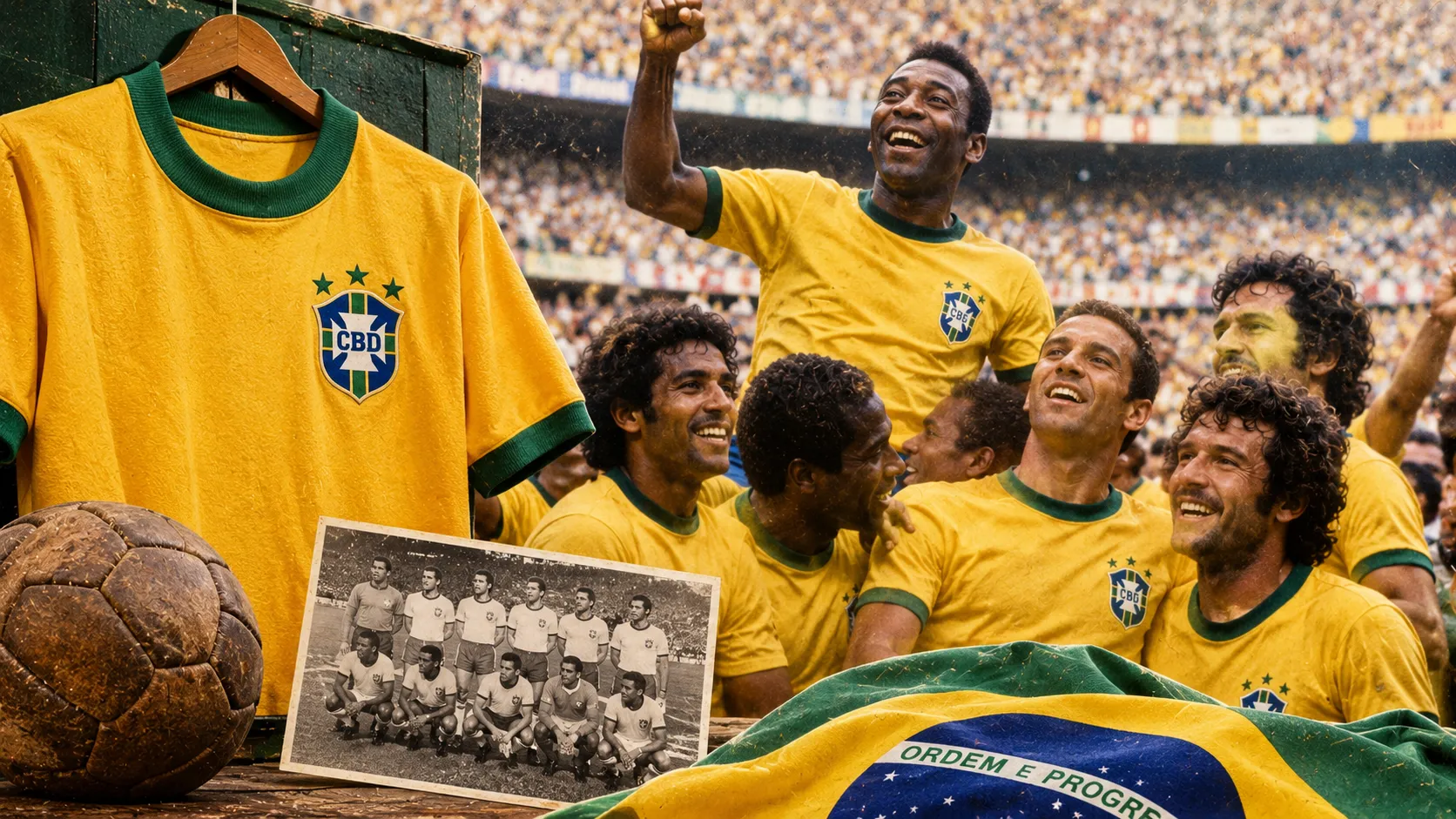
Demand for brazil retro shirts is driven almost entirely by one tournament, and the story attached to it is usually told wrongly. The 1970 side is remembered as pure talent the best collection of footballers ever assembled, winning because they were more gifted than everyone else.
That is half of it. The other half is that they were also the best-prepared team at the tournament, by a distance, and the preparation was based on physiological methods that barely existed in football at the time.
The problem they had to solve
Mexico 1970 was played at altitude and in heat, with matches kicked off at midday to suit European television. Several venues sit well above 2,000 metres, including the Estadio Azteca where the final was played. Those are conditions that punish a side that has not adapted.
Brazil’s response was to go early and train specifically for it. The squad spent weeks at altitude in Mexico before the tournament, which is now standard practice and was then unusual enough to be remarked upon.
The physical programme was built around aerobic testing methods borrowed from American military and aerospace research, which had not previously been applied systematically to footballers. Players were measured, given individual targets, and retested. That sounds unremarkable now. In 1970 it was close to revolutionary, and it is the reason the side could play at that tempo in that heat.
What happened on the pitch
Six matches, six wins, and a 4-1 win over Italy in the final through goals from Pelé, Gérson, Jairzinho and Carlos Alberto. FIFA keeps the full records from the tournament, including Jairzinho’s run of scoring in every round, which no one has repeated.
The fourth goal is the one everyone remembers a move running the length of the pitch finished by the right-back and it is also the best evidence for the fitness argument. That move happens in the eighty-sixth minute, at altitude, in the heat, against Italy. A team that was merely talented does not produce it then.
Mário Zagallo managed the side, having won the tournament as a player in 1958 and 1962. Brazil’s third title meant they kept the Jules Rimet trophy permanently.
Why does the shirt look like that?
Because of a defeat. Brazil played in white until 1950, when they lost the deciding match of their home World Cup to Uruguay at the Maracanã in front of a crowd that remains the largest ever to watch a football match.
The reaction was severe enough that the white shirt was abandoned as unpatriotic. A newspaper ran a competition to design a replacement using all four colours of the national flag, and it was won by a nineteen-year-old from Pelotas named Aldyr Garcia Schlee. Yellow shirt, green trim, blue shorts, white socks.
It was first worn in 1954 and has barely changed since, which is unusual for an international kit and is a large part of why it reproduces so well. There is no era-specific detailing to get wrong.
Was it really the best team ever?
The claim is made more often about this side than any other, and the honest answer is that it is unfalsifiable and still reasonable. Brazil won every match, scored nineteen goals in six games, and did it with a forward line in which four players could plausibly have been the best attacker at the tournament.
The arguments against are worth stating. The defence was the weakest part of the side and conceded in five of its six matches. The goalkeeping was ordinary by the standards of the era. And the tournament was played in conditions that favoured a technical side over a physical one, which is a context advantage rather than a measure of quality.
What is not arguable is the margin. No side has won a World Cup with that combination of results, goals and attacking personnel, and no side has looked less troubled doing it. Whether that makes them the best ever depends on how much you weight dominance against the strength of the opposition, and that argument has run for fifty years without resolving.
Dating a Brazil shirt
Harder than most, precisely because the design is so stable. The markers are supplier, crest treatment, collar, and the number of stars above the badge.
Stars are the quickest route. Brazil added them as titles accumulated, so the count narrows a shirt to a window immediately anything with fewer than five stars predates 2002. The crest itself has had several treatments, and the shape of the shield and the lettering of the inscription both moved over the decades.
Fabric is the other giveaway. The 1970 shirts were heavy cotton with a cut that bears no relation to a modern replica, and any reproduction using modern synthetic fabric will feel wrong in the hand even if it looks right in a photograph. Our guide to football kit fabric covers what changed and when.
How many versions of the shirt are there?
More than people expect, because the stability of the design hides a lot of small variation. The 1970 shirt alone exists in several legitimate forms the match shirts, the contemporary retail versions, and later official reissues, each with slightly different crest embroidery and collar construction.
Then there are the away shirts, which get almost no attention and are in several cases better objects. Brazil’s blue change shirt from the period is a genuinely handsome kit and costs a fraction of the yellow, for the simple reason that nobody is buying it to pretend to be Pelé.
Goalkeeper shirts are the third category and the most overlooked. Félix wore a plain shirt that looks nothing like anything on sale today, and good reproductions of it are rare enough to be interesting.
What the preparation actually produced
Measured output, not just stamina. The side could sustain a passing tempo in the second half that other teams could not match, which is why so many of their goals arrive late in matches.
It also produced availability. Brazil carried fewer injuries through the tournament than most of their rivals, which in a six-match competition played in a fortnight is close to decisive. A squad that can pick the same eleven is a squad whose best players actually play.
The approach spread slowly. European clubs adopted systematic conditioning through the seventies and eighties, and the measurement culture that now defines the sport traces back to work like this. What began as a way of surviving altitude in Mexico became the basis of modern preparation, including the tracking systems covered in how GPS changed football training.
Buying one
Reproductions of the 1970 shirt are widely available and mostly honest, because the design is simple and the licensing is straightforward. What varies is fabric weight, and that is where the money goes a heavyweight cotton reproduction costs considerably more than a polyester one and is a different object.
If you want the one Pelé wore, remember that the number is the expensive part. A plain yellow 1970 reproduction is inexpensive; the same shirt with a correct-period 10 on the back can cost several times as much, and the fakes concentrate there for that reason.
Originals from 1970 exist but are rare and command prices that reflect it. For most buyers the question is reproduction quality rather than provenance, and the honest answer is that a good reproduction of this shirt is an excellent object. Altitude shaped that tournament more than anything else, which is covered in how altitude affects footballers.
Frequently asked questions
Why did Brazil switch from white to yellow?
After losing the deciding match of the 1950 World Cup at home to Uruguay. The white shirt was abandoned and a newspaper competition produced the yellow design, first worn in 1954.
What made the 1970 side so well prepared?
Weeks of altitude acclimatisation in Mexico plus an individualised aerobic conditioning programme based on testing methods borrowed from American military and aerospace research.
How do I date a Brazil shirt?
Count the stars above the crest first fewer than five predates 2002 then check supplier, crest treatment and collar.
Is a 1970 reproduction worth buying?
Yes, if you buy on fabric weight. A heavyweight cotton version is a genuinely different object from a cheap polyester one, and the design is simple enough that good reproductions get very close.