

Most advice on judging a football shirt from a listing is written with white kits in mind, because white shows everything. A red shirt is a different problem. Thin fabric, uneven dyeing and panel variation all hide better against a dark base, which means the checks that work on a white shirt tell you less on a red one.
That does not mean a red shirt cannot be assessed. It means the assessment moves to different places.
What does red conceal?
Opacity, mostly, and fabric weight.
On a white shirt you can hold the garment to a light source, or look at a mannequin photograph, and see immediately whether the knit is too thin. On red, the colour absorbs enough light that a thin shirt and a properly weighted one look much the same in a photograph. The same applies to small variations in the knit density across the garment, which show as faint shadows on white and disappear on red.
So the opacity test, the most useful single check on a white kit, is close to useless here. The weight has to be judged another way.
What does red still reveal?
Panel matching, and it reveals it clearly.
An all-red kit has no pattern to distract the eye, which means the red at the sleeve has to match the red at the body exactly. Panels cut from different dye batches show as a tonal difference at the seam, and on a solid colour that difference is visible in any decent photograph. Anyone comparing liverpool football kits across sellers should make this the first check: look where the sleeve meets the shoulder, and at the side seams, and confirm the red is continuous.
The same applies across the kit. Shirt, shorts and socks are often made from different fabrics with different dye characteristics, and a kit where the shorts are visibly a different red from the shirt was not made with much care.
How do you judge fabric weight on a dark shirt?
From texture rather than transparency.
A quality match-specification knit has visible structure: variation in the weave, more open areas across the back and under the arms, a surface that catches light differently from one panel to another. That texture is visible on red in a close-up photograph even though opacity is not. A completely smooth, uniform surface across the whole garment suggests the cheapest available base cloth, whatever colour it is.
Sellers who photograph the fabric close enough to show texture are giving you what you need. Sellers who provide only flat renders are not.
What about the crest?
The one check that works identically on every colour.
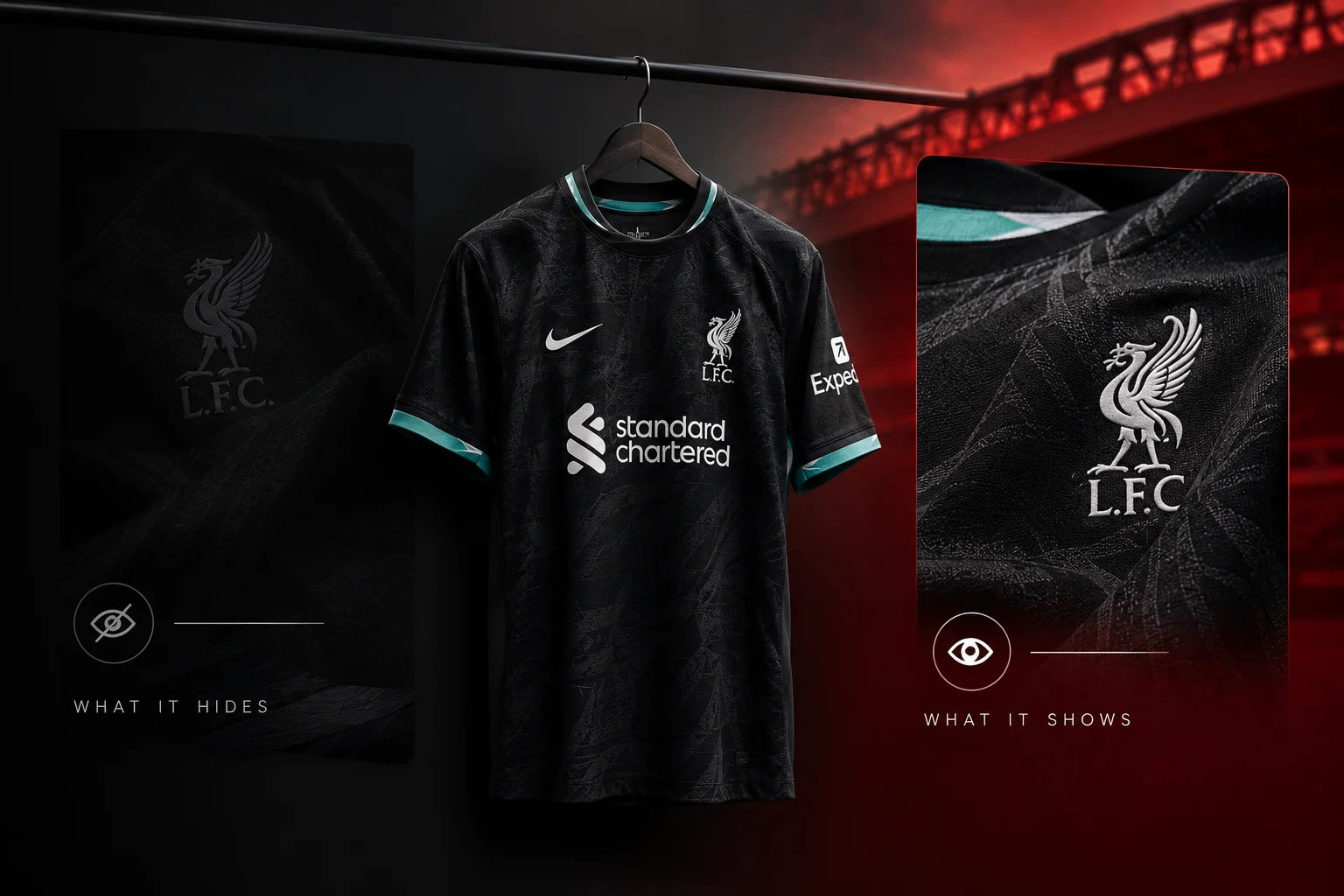
An embroidered crest shows thread texture and sits into the fabric. A properly bonded crest sits flush with clean edges. A heat pressed badge shows a faint outline where the backing film ends, and on red that outline is less obvious than on white but still visible in a good close-up. Heat pressed badges lift at the corners within months of regular washing, which is why the crest photograph is the single most informative image a seller can provide.
The Liver bird has been rendered in several distinct styles across the decades, which also makes the crest a useful dating tool for older shirts.
Does the red itself vary?
Yes, between seasons, and that is normal.
Liverpool’s red has shifted as manufacturers and dye formulations have changed, and shirts from different eras do not match each other. That is not a fault. What is a fault is variation within a single shirt, or a seller whose stock for the same season shows noticeably different shades across listings, which indicates mixed sources with no quality control.
Judge an older shirt against photographs from its own season rather than against the current kit.
Replica or player version on a dark shirt?
The same choice as any kit, with one difference in what you can check.
The replica is heavier, more durable and cut with room. The player version is lighter, tighter and uses more aggressive ventilation, often with bonded seams. On a red shirt the fabric weight difference between them is hard to see in a photograph, so the distinction has to come from the seams, which are visibly different, and from the listing stating clearly which version it is. A seller who sells both should publish separate measurements for each.
What about the shorts and socks?
Part of the same kit, and often where the colour matching fails first.
A full Liverpool kit is red throughout, which means the shorts and socks have to match the shirt. They are frequently made from different fabrics, since shorts need more stretch and socks more durability, and different fabrics take dye differently. A kit where the three pieces are visibly different reds was not made with much care, and the mismatch is obvious on a pitch or in a photograph.
Sizing is separate too. Shorts are cut on the waist rather than the chest, so a kit sold in a single size assumes both measurements line up. For plenty of buyers they do not, and buying the pieces separately gives a better result.
How does the kit perform?
The same way as any modern shirt, with one difference that matters in summer.
Dark colours absorb more heat from direct sunlight than light ones. On a hot day, a red shirt worn in the sun will feel warmer than a white one of identical construction. The effect is modest and the ventilation structure of the fabric matters far more, but it is real, and it is one reason summer away kits are so often pale.
For the fabric science behind that, our breakdown of how football kit fabric actually works covers why the knit structure matters more than the colour.
Does the shirt change between seasons?
Less than at most clubs, which is useful if you are deciding whether to buy current or wait.
With no pattern to alter and no second colour to rebalance, variation between Liverpool seasons is limited to the collar, the trim, the shade of red and the fabric texture. A shirt from two or three seasons ago still looks current to anyone not studying the collar, and last season’s kit is reliably the best value in the range. The home shirt dates slowly in appearance even as it ages in status.
What to check, in order
Panel matching at the seams first, since red shows it clearly. Fabric texture in close-up, since red hides weight. Crest attachment, which works on any colour. Then the shade against the season’s photographs for anything older than the current kit.
Four checks, each visible from a listing, and together they cover what a dark shirt would otherwise hide.
Frequently asked questions
How do I check the quality of a red football shirt?
Look at panel matching at the seams, fabric texture in close-up photographs, and how the crest is attached. The opacity test that works on white shirts is unreliable on dark colours.
Why does Liverpool’s red look different on older shirts?
Manufacturers and dye formulations have changed over the decades, so shirts from different seasons do not match. Variation within a single shirt is a fault; variation between seasons is normal.
Are dark football shirts hotter to wear?
Slightly, in direct sunlight, because dark colours absorb more heat. The fabric’s ventilation structure matters far more than its colour.