

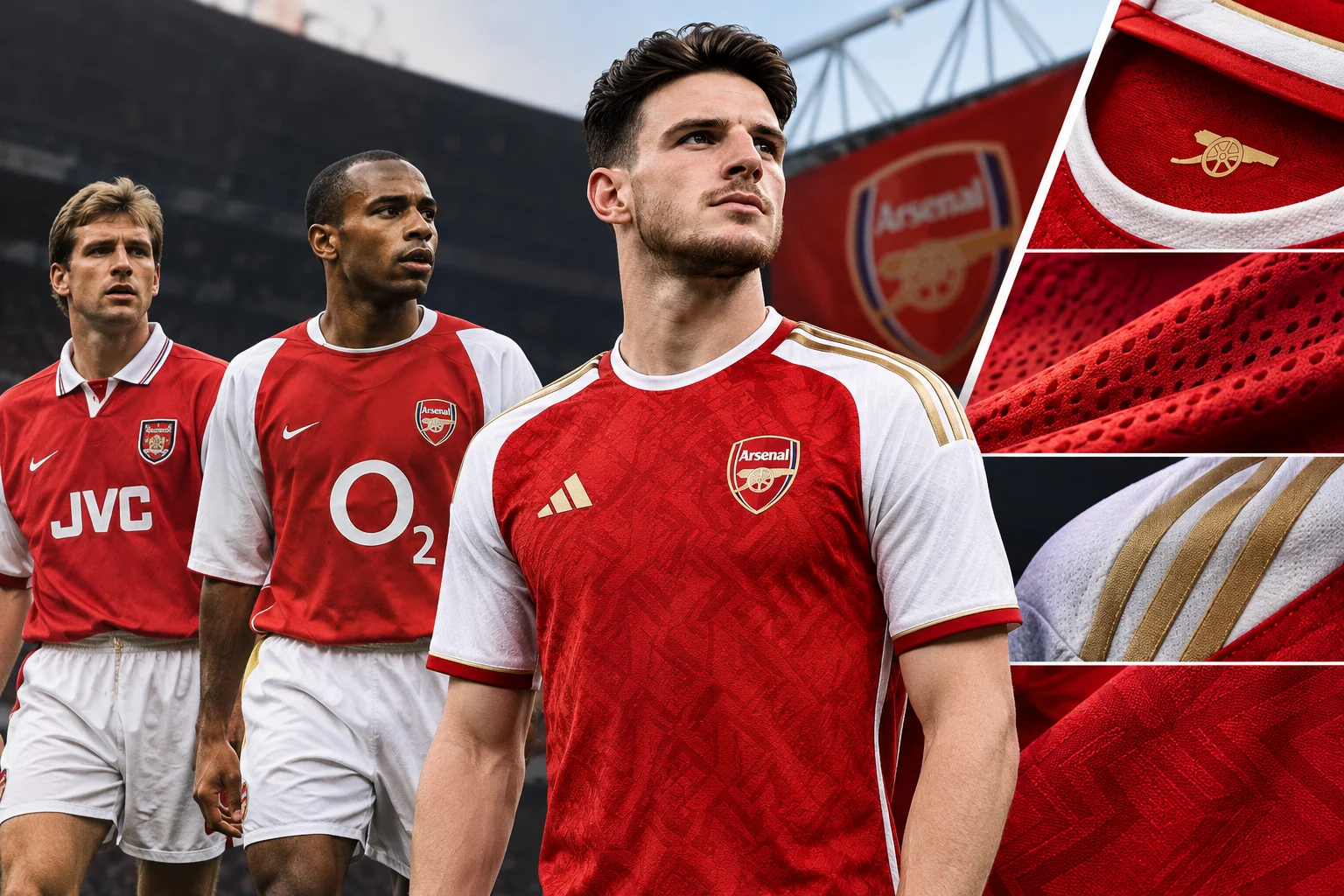
Put a 1998 Arsenal shirt next to a current one and the obvious differences are the collar, the sponsor and the cut. The differences that matter more are invisible. The fabric is a different material behaving in a different way, the panels are arranged to solve a problem the older shirt did not try to solve, and the whole garment weighs substantially less.
Red and white has stayed red and white. Almost everything underneath it has been replaced.
From cotton to polyester, and why it happened
Football shirts were cotton for most of the game’s history because cotton was what existed. It is comfortable dry and it is a poor choice wet, because it absorbs moisture into the fibre itself and holds it there. A cotton shirt in the eightieth minute of a warm match is heavy, cold against the skin and slow to dry.
Polyester behaves differently at a structural level. The fibre itself absorbs very little, so moisture travels along the surface and between the fibres rather than into them. That is what allows it to move sweat away from the skin and spread it across a wider area where it evaporates faster.
The practical result for anyone wearing one is a shirt that stays lighter and dries quicker. The practical result for anyone buying one is that fabric quality now determines comfort far more than it used to, because the whole mechanism depends on how the knit is constructed.
How does the knit affect performance?
The fibre is only half of it. How that fibre is knitted determines how well the system actually works.
A tight, flat knit moves less air and wicks less effectively. An open, textured knit with varied density moves more air and spreads moisture over a larger surface. This is why good arsenal football shirts and their equivalents at other clubs have visible texture when you look closely, and why a completely smooth surface across the whole garment usually indicates a cheaper base cloth.
Look for variation across the shirt in close up photography. Well made shirts are not uniform. The back and the underarm panels are frequently a more open structure than the chest, because those are the areas that need to shed heat fastest.
Why are the panels arranged the way they are?
Body mapping is the term, and the principle is simple: different parts of the body produce heat and sweat at very different rates, so a single fabric across the whole shirt is a compromise everywhere.
The upper back and the area between the shoulder blades run hottest. The underarms produce the most moisture. The chest and the lower front run cooler. So a shirt built properly uses a more open, ventilated structure across the back and under the arms, and a denser one where the sponsor and crest need a stable surface to sit on.
You can see this in any decent product photograph. Visible mesh panels on the back are not a styling choice. They are there because that is where the heat is.
Has the fit changed as much as the fabric?
More, arguably, and it is the change people notice first when they buy an older shirt.
Shirts from the 1990s were cut with enormous room through the body and sleeve, partly for comfort and partly because the fabric of the time needed air space to work at all. As polyester wicking improved, the cut tightened, because a shirt that sits closer to the skin moves moisture away from it more effectively.
That creates a practical problem when buying across eras. A large from 1996 and a large from today are not the same garment. If you are buying anything older, measurements matter far more than the size letter, and the gap is frequently a full size or more.
Replica or player version?
Two genuinely different builds, and the difference is greater now than it has ever been.
The replica is made for wearing. It is cut with some room, uses a slightly heavier and more durable knit, and is built to survive repeated domestic washing. That durability is the point, because a fan shirt goes through the machine far more often than a match shirt does.
The player version is made for playing. It is lighter, tighter, uses more aggressive ventilation and often bonded rather than stitched seams to reduce friction. It is also less forgiving on fit and less robust over time. Unless you are actually playing in it, the replica is the more sensible purchase, and the size charts are not interchangeable.
What does this mean when you are buying?
It gives you concrete things to look for rather than a vague sense of quality.
Check for visible texture variation across the shirt rather than a uniform flat surface. Check the back and underarm areas specifically for a more open structure. Check the crest is embroidered or properly bonded rather than heat pressed, since heat pressed badges lift at the corners within months. Check stitching density at the hem and cuffs, which take the most stress.
All four are visible in good product photography. A seller who only provides flat renders is not giving you enough to judge, which is worth knowing before you order rather than after.
How should you wash a modern shirt?
This matters more than with cotton, because the performance depends on the fibre surface staying clean and uncoated.
Wash cool at thirty degrees, inside out. Skip fabric softener entirely, because it coats the fibres and directly reduces the wicking that the fabric was engineered to do. A shirt washed repeatedly with softener stops working as intended and there is no easy way back.
Avoid the tumble dryer. Heat lifts heat pressed crests, cracks printed numbers and can damage bonded seams. Air drying is faster than people assume with polyester, since the same properties that shed sweat also shed water in a drying rack.
The short version
The red and white has not changed. Everything inside it has. What you are choosing between when you compare two shirts at different prices is largely the quality of the knit and the care taken over the panel structure, both of which are visible if you know to look.
For a club where the colour itself is the hard part, our piece on how Manchester City player versions differ from replicas takes the same approach to a different problem. And for the shirt that shows how far Arsenal’s design has travelled, the bruised banana story covers the most famous away kit the club has produced.
Frequently asked questions
Why do modern football shirts feel so much lighter?
Polyester absorbs very little moisture compared with cotton, and modern knits are engineered to be as light as possible while still ventilating. A current shirt can weigh less than half what an equivalent cotton shirt did.
Are Arsenal shirts from the 1990s sized differently?
Substantially. Shirts from that era were cut much looser through the body and sleeve. Always buy older shirts on measurements rather than the size letter, since the difference is often a full size or more.
Does fabric softener damage football shirts?
It coats the fibres and reduces the wicking performance the fabric was built for. Washing without softener, inside out and at thirty degrees, preserves both the fabric behaviour and any printing.